Author Archives: Alison German

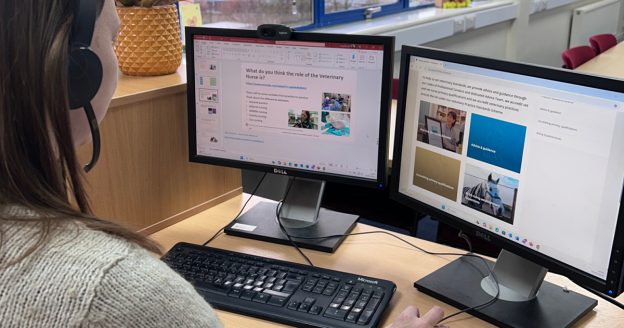
Lecturer preparing to deliver a Live Online lesson

CAW Students’ Programme Choices Reduce Carbon Emissions and Saves Them Money!

The College of Animal Welfare (CAW) is proud to announce significant strides in environmental sustainability, having saved nearly 130 tonnes in carbon dioxide (CO₂) emissions during 2025 through students choosing programmes that utilise innovative Live Online learning over traditional face-to-face classroom attendance. 

In addition to the environmental benefits, students are also making their own financial savings in travel at a time when the cost-of-living crisis is placing a strain on personal finances. 

This achievement reflects the College’s ongoing commitment to reducing its carbon footprint and supporting wider efforts to combat climate change.

Barbara Cooper, College Principal, said “By offering Live Online teaching and integrating renewable energy technology, the College has not only enhanced accessibility for students but also made a meaningful contribution to the environment.”

Key Carbon Savings Highlights

  • Online Teaching: 128tonnes of CO₂ saved thanks to reduced student travel.
  • Travel reduction:  365,000 miles of travel saved at an estimated cost of over £160,000*
  • Student savings:  The average student choosing the Live Online learning option saved over £400 in travel costs last year*

By increasing the use of Live Online learning, CAW has helped eliminate the need for numerous student commuting journeys each year – a direct way to reduce transport-related emissions and reduce the cost of programme attendance for both students and employers.

These achievements support the College’s broader sustainability goals, which include embedding environmental awareness in teaching, encouraging low-impact travel choices, and pursuing further energy-efficient technologies across its campuses.

“Every tonne of carbon saved brings us closer to a healthier planet and sets an example for future professionals,” added Barbara Cooper.

CAW remains dedicated to evaluating and expanding strategies that reduce its environmental impact while empowering students to become responsible, forward-thinking leaders in their chosen fields.

* HMRC wear and tear and fuel rate used = 45p per mile.

The Power Hour

The Power Hour Returns: 60 Minutes to Level Up Your Leadership

Following the overwhelming success of last year’s Power Hour series, we’re thrilled to announce that The Power Hour is back for 2026!

This popular series of hour-long leadership and coaching webinars is designed specifically for those working in veterinary practice who want to grow their leadership confidence, strengthen team performance, and develop their coaching skills — all in just 60 minutes.

Each Power Hour webinar offers practical, takeaway strategies you can apply straight away in your day-to-day role, along with a live Q&A session to help you explore your own challenges and experiences in practice.

What to Expect

Each session focuses on a key aspect of leadership, coaching, or team management, tackling the real-world challenges faced by those in veterinary practice. You’ll gain actionable insights to help you lead with confidence and clarity, build stronger communication within your workplace, manage performance and conflict effectively and develop a positive and resilient practice culture.

Forthcoming sessions:

Each webinar is £20 + VAT, and includes a one-hour CPD certificate for attendees.

If you’re a CAW Clinical Coach, work within a CAW Approved Training Practice, or are a CAW Alumni member, you can attend for just £10 – simply email admin@caw.ac.uk for your exclusive discount code before booking.

Whether you’re looking to refine your leadership style, build stronger teams, or grow as a coach and mentor, The Power Hour 2026 is the perfect opportunity to invest in your professional development — one hour at a time.

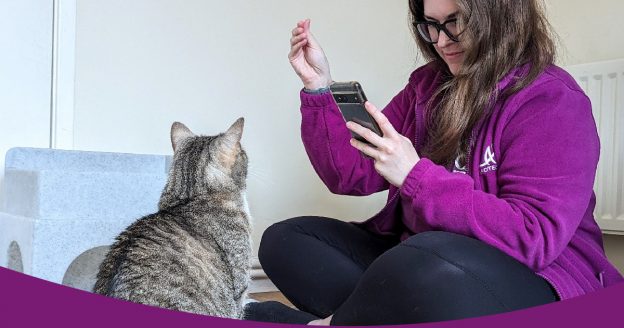
Lady sitting on the floor showing a cat some treats

Volunteer with us at Cats Protection!

Cats Protection helps around 200,000 cats and kittens every year but we would not be able to make such as difference without the dedication of our volunteers.

We’re lucky to have over 10,000 volunteers across cats Protection, contributing their time and skills across every aspect of the organisation.  From rehoming cats and looking after them in our centres and branches, to fundraising in our charity shops and supporting with a breadth of activities across the organisation.

There are a huge range of volunteering opportunities that will really help us have a positive impact on cat welfare whilst also offering the opportunity to apply and develop your skills throughout your career.

We have a range of volunteering roles that mean you can apply the skills you have already in a charity context for the benefit of cats.  If you are looking to develop your career, there are a range of roles that will enable you to develop your skills with practical experience.

We have roles in our;

  • Shops
  • Centres and branches
  • Fostering, including Lifeline fostering opportunities
  • Neutering, including trap, neuter, vaccination and release of feral cats
  • Fundraising

No matter what role you choose to do, we will make sure you get all the training and equipment you need to maximise the use of your generously donated time.  We also have a range of online courses you can take, covering topics on cat welfare as well as more role specific learning, to help you develop and apply your knowledge and skills.

To find out more about volunteering with Cats Protection, visit www.cats.org.uk/get-involved/volunteering

Studying

Why a Wider Curriculum Builds Better Veterinary Care Professionals

As educators in the vibrant field of veterinary care in the distance learning department of CAW, we are united by a single, powerful goal: to shape the next generation of skilled, compassionate, and effective professionals. Our Level 2 Veterinary Care Support and Veterinary Care Assistant  programmes provides an essential foundation in technical skills, but true excellence is achieved when we look beyond the textbook. It’s about integrating the wider curriculum, the threads of Maths, English, British Values, Ethics, Prevent, and Safeguarding into the very fabric of our teaching and resources.

This holistic approach does more than just tick a box; it transforms our learners from students into practice-ready team members, equipped to handle the complex realities of a veterinary environment.  In a clinic, clear communication is as crucial as clinical accuracy. By weaving English skills into practical application, we move far beyond essay writing.  Imagine learners drafting detailed case notes, compiling concise client summaries after a consultation, or writing crystal-clear post-operative care instructions. These tasks build the precise language skills needed every day in practice.  Furthermore, through role-play like explaining a complex procedure to an anxious owner or collaborating with a senior vet they build the confidence and empathy that define exceptional client care. Practicing how to explain the necessity of a flea treatment in simple, reassuring terms is a perfect example of English in action. Maths in our sector is never just theoretical; it’s a fundamental pillar of patient safety. Our integration strategy makes numeracy tangible and urgent.  Learners assist in critical calculations for drug dosages based on an animal’s weight, work out precise feed rations for hospitalised patients, and even determine costings for client quotes. They learn to accurately measure fluid intake, and meticulously record vital signs. This ensures that when they qualify, their number skills are instinctive and error-free.

Our duty extends beyond the treatment room to preparing learners to be responsible members of their community and profession. Embedding British Values, Ethics, Prevent, and Safeguarding is key to this.  We facilitate discussions on how British Values translate directly to the clinic: respecting a client’s right to choose a treatment plan (Individual Liberty), adhering strictly to the Animal Welfare Act (Rule of Law), and treating every client and colleague with dignity (Mutual Respect and Tolerance).  The Prevent duty is contextualised, helping learners understand their role in maintaining community safety. This involves vigilance, such as recognising and reporting any suspicious behaviour regarding the purchase or use of chemicals that could be misused.  Most critically, Safeguarding training empowers them to become advocates for animal welfare. They learn to identify the subtle and overt signs of abuse or neglect, understand the protocols for reporting concerns, and appreciate their ethical responsibility as frontline observers.

By actively embracing this wider curriculum, we do more than teach, we simulate the real world. We create a learning environment that values compassionate communication as much as clinical precision, and ethical responsibility alongside technical skill.  This approach ensures our learners aren’t just exam-ready; they are life-ready. They enter the workforce as truly capable, confident, and compassionate veterinary care professionals, prepared to make a meaningful difference from their very first day.

Pride Disability Month Banner

Celebrating Disability Pride Month at The College of Animal Welfare

July is Disability Pride Month – a time to celebrate the strength, resilience, and achievements of disabled people, while also raising awareness of the barriers that continue to exist in society. At The College of Animal Welfare, we are committed to ensuring that all our students can thrive and achieve their goals in an inclusive, supportive learning environment.

Disability Pride Month is not just about recognising challenges; it is about celebrating identity, community, and pride. Whether you identify as disabled, have a long-term health condition, or are neurodivergent, we want you to feel valued, respected, and empowered in your studies.

How we support our students

We understand that everyone’s learning journey is different. That’s why we offer a range of services and adjustments to ensure you have equal access to your course and can reach your full potential:

  • Free confidential counselling (in-person or online). All students can access up to six sessions of counselling for support with mental health, personal challenges, or academic pressures.
  • Learning Support Team. Our experienced team offers tailored support for a wide range of conditions, including sensory and mobility needs, mental health, and neurodiversity such as dyslexia, ADHD, and autism.
  • Assistive technology tools. Read Aloud extensions for Chrome to support online learning
  • Our online eLibrary resources allow you to highlight, enlarge, and read aloud textbooks to suit your needs.
  • Accessible learning materials. Written materials for lectures are provided in advance to give you time to prepare and engage fully in class.
  • Exam concessions and reasonable adjustments. We support you in gaining appropriate exam concessions and adjustments to ensure fair assessment.
  • Dyslexia Referral Process. If you think you may have dyslexia, we can support you through our referral process to access the help you need.

Suggestions?

If you are a CAW student or member of staff and have any suggestions on how we can further support people with disabilities, we would love to hear your ideas – please pop them into our online suggestion box.

You are not alone

Disability Pride Month is a reminder that disability is an important part of human diversity and that inclusion benefits everyone. If you would like to discuss any support needs, please do not hesitate to contact the Learning Support Team on learningsupport@caw.ac.uk. We are here to help you succeed and feel proud of who you are.

This July, join us in celebrating Disability Pride Month – and in working together towards a truly accessible and inclusive future.

Celebrating the 500th CAW VetSkill Apprentice to Become an RVN!

We are thrilled to announce a major milestone for The College of Animal Welfare (CAW): our 500th VetSkill veterinary nurse apprentice has officially qualified and joined the ranks of Registered Veterinary Nurses!

Huge congratulations go to Thomas Pocock, who has completed his apprenticeship and achieved his RVN status through our veterinary nursing programme. This is a significant achievement not just for Thomas, but for the entire College, and we couldn’t be prouder.

Thomas is currently serving with the Royal Army Veterinary Corps (RAVC). The College of Animal Welfare is proud to be involved in the training of the RAVC veterinary technicians, supporting them on the path to becoming fully qualified veterinary nurses; Thomas’s success highlights the strength of this partnership.

Commenting on his success, Thomas said: “Becoming a Registered Veterinary Nurse has been a proud moment in my miliary career. Embarking on this journey with The College of Animal Welfare two years ago, has been a career highlight of mine. The skills taught throughout the apprenticeship will no doubt follow me around the world as I continue to care for military working animals. To be the 500th VetSkill apprentice has been the icing on the cake for what has been a thoroughly enjoyable and informative experience”. 

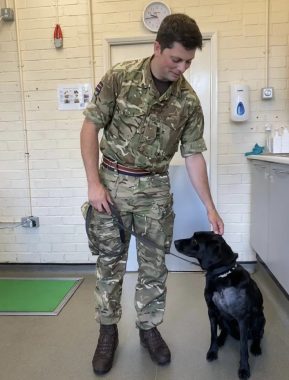
Thomas working at the Defence Animal Training Regiment

Since the VetSkill apprenticeship programme began, we have worked with employers and students across England from a variety of backgrounds and workplaces, helping them to develop the knowledge, skills, and professional confidence to thrive as veterinary nurses. Reaching the 500th milestone is a testament to the hard work of our learners, the commitment of our teaching staff, and the valuable partnerships we have with practices and organisations.

We look forward to supporting the next 500 apprentices—and beyond!

Forthcoming Changes to the VN Apprenticeship

Trailblazer working with RCVS and IfATE to explore a new approach to the VN Apprenticeship

The Institute for Apprenticeships and Technical Education (IfATE), with RCVS support, have clarified that the review by the Veterinary Nursing Trailblazer group, which is made up of representatives from employers, training providers, end-point assessment organisations, the RCVS and IfATE, is working on replacing the current Level 3 Veterinary Nurse Apprenticeship Standard with a new Standard that will move the new apprenticeship to being a statutory integrated end-point assessment (EPA) wholly regulated by the RCVS.

The assessment prescribed by a statutory regulator will constitute the apprenticeship’s EPA. Thus, achieving the apprenticeship leads to attainment of the regulator’s requirements. The apprenticeship is then referred to as being a statutory integrated apprenticeship.

This approach simplifies and strengthens how EPAs work for statutory integrated apprenticeships. This ensures parity for apprentices in assessment terms by aligning with people on other training routes.

As no formal submission has yet been made to IfATE, changes are still possible, but the revised apprenticeship will have a new standard reference number, with integrated qualifications mapped to the apprenticeship, RCVS day one competences, skills, and professional behaviours. The new apprenticeship standard will continue to include an RCVS accredited ‘licence to practise’ qualification in Veterinary Nursing in compliance with the requirements as stated in the RCVS Standards Framework for Veterinary Nurse Education and Training.

In practical terms, apprentices will not require any additional assessment beyond the regulator requirements. Under this structure, if approved, the assessment requirements will be those of the regulator approved mandated qualification. As the RCVS accredited VetSkill qualification does not have a professional discussion currently, this means it is likely that there will no longer be a professional discussion requirement for apprentices who are registered with The College of Animal Welfare on the new Standard.

The OSCE will still be required to be passed within an RCVS accredited ‘license to practise’ qualification. Thus, all qualification assessment requirements will be achieved before the Apprentice passes through the gateway.

Apprentices in training under the new standard will achieve the VN qualification (including OSCEs) and then will apply to pass through the gateway, and if successful, will be awarded the Apprenticeship Standard achievement certificate as well as their VN qualification certificate. The criteria for passing through the gateway will be that all of the requirements of the new apprenticeship will have been achieved. The details of what this entails has not yet been determined and is work in progress within the trailblazer group and subject to final approval.

Once the new Apprenticeship Standard becomes available the current standard will be phased out to new apprentices. Where an apprentice is already engaged on a standard which has been replaced with a new apprenticeship standard (that is with a new ST code), this would be treated as a change of programme. It is envisaged therefore that apprentices who have already commenced their training under the current apprenticeship standard will not be permitted to transfer to the new apprenticeship standard to avoid taking the professional discussion.

It is envisaged that the current standard (ST0343) will remain available for new starts until at least April 2026, and those starting it will complete under this existing standard. The new statutory integrated apprenticeship standard is expected to launch sometime after April 2026.

The funding value of the new apprenticeship will also be reviewed and a formal submission made to IfATE alongside the revised apprenticeship standard and EPA. The trailblazer group has commenced the process of collating information to support their submission.

Thus, in summary:

  • The current VN Apprenticeship standard will remain in place until a new Standard replaces it. This approach for apprentices will ensure parity with people on other training routes in assessment terms. There will be not requirement for additional assessment.
  • Apprentices already in training under the current standard will NOT be able to transfer to the new standard.
  • VN Apprentices will have to finish their apprenticeship under the ST number that that started on.
  • The new VN standard is not expected to become available until after April 2026.
  • The assessment requirements will be those required by the qualification – it is likely there will not be a professional discussion requirement.
  • OSCEs will remain but will take place before the gateway and within their VN qualification.
  • The VN qualification has to be achieved before passing through the gateway.
  • The funding value of the new apprenticeship is still to be determined.

The trailblazer review is ongoing, and a formal submission not yet made to IfATE so may still be subject to change.

We will continue to keep you updated on developments.
The Power Hour

The Power Hour: 60 minutes to level up your leadership

We are excited to announce The Power Hour, a new series of hour-long webinars designed to empower those working in veterinary practice with practical, takeaway, leadership and coaching tips. Each session will focus on key topics that will help you lead with confidence, foster growth in individuals and manage teams effectively.

The topics have been chosen to address the unique challenges of those working in the veterinary industry, and will be followed by a Q&A session to allow you to discuss any challenges you may have in your own team or practice.

2026 and Beyond…

Each webinar is priced at £20 + VAT, and places can be booked by following the links above. A one hour CPD certificate will be available to attendees. If you are a CAW clinical coach, a member of a CAW approved Training Practice or an alumni member then you can book a place for just £10 – email admin@caw.ac.uk for the discount code to be used at the checkout.

Supporting Your Wellbeing Over Christmas with Togetherall

The holiday season is here – a time often filled with joy, celebration, and connection. However, it’s also a period that can bring challenges, whether it’s feeling overwhelmed, coping with loneliness, or managing personal struggles. At times like these, it’s important to remember that you are not alone. That’s where Togetherall comes in.

What is Togetherall?

Togetherall is an online community that is free to use for all students and staff of The College of Animal Welfare. It provides a safe, anonymous space to share your feelings, find support, and access resources 24/7; it’s designed to help you cope with whatever life throws your way.

Whether you’re navigating stress, anxiety, or just need someone to listen, Togetherall offers a variety of tools to help you feel supported:

1. Share Anonymously with Others
The Togetherall community is filled with people experiencing similar feelings. You can share your thoughts or simply read others’ posts to feel less alone. Everyone’s voice matters, and the anonymous nature of the platform ensures a safe and judgment-free space.

2. Access to Trained Professionals
While Togetherall is a peer-to-peer support platform, it’s also moderated by trained professionals who ensure the community remains a safe and supportive environment.

3. Tools and Courses for Personal Growth
Explore self-help resources, courses, and tools to help you manage your mental health. From learning relaxation techniques to building resilience, these resources are available to you whenever you need them.

4. Available Anytime, Anywhere
Togetherall is accessible wherever you have an internet connection. This means you’ll never be without support, even on Christmas Day.

Not accessed Togetherall before?

It is quick and simple to access. Simply visit the Togetherall website, register using your college email address and explore the community, courses, and resources available to you!

The Bursary winner and Laura's mum

Announcing the 2024 Winner of the Laura Turnbull Bursary: Rheana Lala

The College of Animal Welfare is delighted to announce that Rheana Lala, a third-year BSc (Hons) Veterinary Nursing student, has been named the 2024 recipient of the Laura Turnbull Bursary. The award recognises Rheana’s dedication to animal welfare, her academic achievements, and her inspiring vision for the future of veterinary nursing.

Remembering Laura

Laura was an extraordinary veterinary nurse; she had great compassion for animals and a particularly deep connection to India, where she spent time working and helping to improve standards of veterinary nursing care. The bursary, which is awarded annually, is joint funded by Laura’s family and The College of Animal Welfare. It aims to keep Laura’s memory alive and support students who embody her values of innovation, dedication, and a commitment to making a difference.

About Rheana

Rheana’s story echoes Laura’s in many ways. Before starting her veterinary nurse training, Rheana gained over a year of practical experience at Crown Vet, a veterinary hospital in India, where she developed her foundational skills and strengthened her resolve to pursue a career in veterinary nursing. Coincidentally this is the same veterinary hospital that Laura worked in during her time spent in India. Rheana and Laura both share a profound connection to India and a dedication to improving the lives of animals through education, advocacy, and innovation. Rheana’s commitment to creating sustainable change and her passion for animal welfare mirror Laura’s lifelong mission, making her a truly fitting recipient of this year’s bursary.

How the Bursary Will Make a Difference

Rheana plans to use the £1,000 bursary to support her participation in a month-long volunteering programme at a wildlife rehabilitation centre in Australia to gain invaluable hands-on experience working with injured and displaced wildlife. She hopes her time spent out there will deepen her understanding of wildlife rehabilitation and conservation, and help towards her ultimate goal of advancing veterinary nursing in India.

Rheana officially received the bursary at The College of Animal Welfare’s Student Awards Ceremony on Saturday 16 November where she had the opportunity to meet Laura’s mum and sister.

Congratulations Rheana on this well-deserved recognition, we look forward to hearing about your time in Australia!