Author Archives: Alison German

Help us give animals across the UK a happier Christmas this year

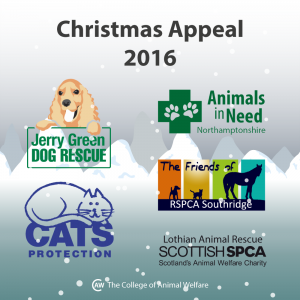
Christmas Charity Appeal Logos


Christmas is all about giving, and this year all of our centres are collecting donations for local animal charities to help make their Christmas day a little more special. Anything you can donate will help make a difference.


Huntingdon – Animals in Need

Animals in Need is a rescue organisation that was set up in 1990, run solely by volunteers to rescue sick, injured, trapped and distressed wild and domestic animals in the Northamptonshire area. Over the Christmas period there will be many animals staying at the shelter, please help to make this a special time for them too. They currently have 500 animals, 125 of which are hedgehogs so any donation, however big or small would be very much appreciated. Animals in Need’s wish list includes items for dogs, cats, hedgehogs, rabbits, guinea pigs, ferrets, rats, chickens or birds, such as:

  • Hedgehog food (cat food/chicken in Jelly)
  • Food and treats
  • Toys
  • Collars and leads
  • Blankets and towels

They also have an amazon wish list should you wish to purchase an item from that:

How to donate:
Leave your item in our collection box in reception.

Potters Bar – The Friends of Southridge RSPCA

The Friends of Southridge RSPCA is a small charity allied to the RSPCA Southridge Animal Centre in Hertfordshire which, at any one time, could be caring for over 300 rescued animals. Every penny donated to the Friends is spent on the animals.

Please help the Friends to make Christmas day special for all the animals at Southridge RSPCA by donating to their Christmas Dinner Appeal. A gift of just £3 will buy one dinner, treat or toy.

How to donate:
Please either leave your donation with reception, go online via www.friendsofrspcasouthridge.org.uk or send a cheque (made payable to ‘Friends of RSPCA Southridge’ to Christmas Dinner Appeal, Friends of RSPCA Southridge, Packhorse Lane, Ridge EN6 3LZ)

Leeds – Jerry Green Dog Rescue and Cats Protection

Jerry Green Dog Rescue care for, and rehome, abandoned and unwanted dogs. They receive no state or lottery funding and so are very much dependant on the generosity of the public to support and enable their important work. Please support this fantastic charity by donating to their treat and toys appeal:

  • Any training treats (including spam and hotdogs sausages)
  • Tennis balls
  • Collars (small and medium) and leads

Cats Protection is the UK’s leading feline welfare charity. As well as finding good homes for cats in need, they support and encourage the neutering of cats and strive to provide information to help improve people’s understating of cats and their care. Please help us support the charity this Christmas by donating any of the following:

  • Cat toys
  • Scratch posts
  • Cat food

How to donate:
Leave your item in our collection box in reception.

Edinburgh – Lothian Animal Rescue (Scottish SPCA)

This Christmas our Edinburgh centre have organised a reverse advent calendar for Lothian Animal Rescue (Scottish SPCA). The reverse advent calendar is all about giving a little something instead of receiving. Please help support the work of this dedicated charity by donating food in our food collection box in reception. The shelter has a wide range of animals from fish to horses, so anything would be appreciated. Some students have already indicated that they are willing to donate other items like horse blankets; all of which will be very gratefully received.

How to donate:
Leave your item in the food collection box in reception.

Thank you to everyone who helps by donating a gift this Christmas.

Nursing Progress Log: Professional Behaviour Evaluation

The newly developed Veterinary Nursing Day One Competences embed greater emphasis on professionalism and accountability. In turn, there is now an assessment tool in the new version of the Nursing Progress Log (NPL) which is designed to aid veterinary nurse students in the acquisition of skills in self-evaluation and self-development within a veterinary team, which should be incorporated in their professional practice throughout their careers. The assessment tool identifies four practice levels: Practices with constant supervision, practices with assistance, practices with decreasing supervision and practices independently. At the point of registration students should reach Level 4/ Practices independently across all criteria within the professional behaviour evaluation.

Clinical coaches that have supported BSc and L3 Diploma placement students from The College of Animal Welfare will recognise that this new evaluation tool is not dissimilar to the Behavioural Tool that you have been completing for many years and this will not change. BSc students studying with The College of Animal Welfare will not be required to complete the new NPL version but will be required to continue with the Behavioural Tool. Second year Diploma students (employed or placement) will also be required to complete the Behavioural Tool and to bring this in line with the new NPL evaluation we are reducing the frequency of this to mirror the new NPL, requiring it to be completed around 10%, 40% and 80% NPL completion. Both the Professional Behaviour Evaluation and the Behavioural Tool will be subject to audit and failure to achieve Level 4/ Practices independently may delay RCVS registration.

If you have any queries about either the Professional Behaviour Evaluation or the Behavioural Tool please do not hesitate to contact your Quality Assurance Supervisor.

Rescue warning from the Kennel Club as advert sends boxer pup searches soaring

boxerThe Kennel Club has reminded people about the importance of carefully choosing a dog after the annual John Lewis Christmas advert, featuring ‘Buster’ the Boxer, has sent searches for Boxer dog puppies to record highs.

Figures released by the Kennel Club show that searches for Boxer puppies on its Find A Puppy website, rose by 160 per cent in the day following the release of the advert. The interest continued in the following days, with searches up a total of 169 per cent in the five days since the advert’s release and by 151 percent on the same period in 2015.

Caroline Kisko, Kennel Club Secretary, said: “We have seen unprecedented levels of interest in the Boxer dog breed since the John Lewis advert was aired, whereas interest in other breeds during the same time has stayed relatively static. The Kennel Club’s Find a Puppy service is a tool for people to use when looking for a dog breeder with a litter of puppies, so people are already actively seeking Boxer pups as a result of the advert. When there is a sudden and enormous spike in people searching for puppies within a breed that is in the media spotlight, we all too often see the same breed overflowing from rescue centres a few months later. It is understandable that adverts, films and other media will feature and celebrate dogs given that we are a nation of dog lovers, but the Boxer breed could be in real trouble if people let impulsiveness take over and rush out to buy one without knowing much about the breed. While the John Lewis advert perfectly depicts the Boxer’s playful and endearing nature, no advert can give a fully rounded picture of what any dog breed is like, so it is essential that people do their research if they are looking to get a dog. We would strongly urge anyone who is serious about getting a Boxer to go to a responsible breeder, such as a Kennel Club Assured Breeder or consider a rescue dog”.

Betty Hoad of the Southern Boxer Rescue Service, has voiced concern about seeing an influx of Boxers through their doors in the New Year. She said: “Boxers are absolutely wonderful characters but we fear being inundated next year, after the interest the John Lewis advert has generated in the breed. We saw lots of Boxers called George coming into us after the Colman’s Mustard ad featuring a Boxer, so we know it happens. Boxers drool, they are messy eaters, and whilst they are fun and playful it means that they also need a lot of exercise and stimulation. They are bouncy, do not look where they are going and blunder about, so people need to be aware of this, particularly if they have children. Neither do they like being left alone, so if you are out working all day, it is not the dog for you.”

To educate people on Boxers following their tremendous boost in popularity, the Kennel Club has launched a ‘Living with Buster’ page on its website, to show people more about the reality of living with the Boxer breed.

The Kennel Club is also inviting people to come and meet Boxers at the Discover Dogs zone at Crufts on 8-11 March 2017, at the NEC in Birmingham, where people can find out more about the breed, and other breeds of dog, and whether they are right for their lifestyle.

Nursing Progress Log (NPL) back online

We have been informed by the Royal College of Veterinary Surgeons (RCVS) that the Nursing Progress Log (NPL) is now back online. Unfortunately the crash means that activity submitted between 01.30 and 08.00 on 15 November 2016 (Tuesday morning) may have been lost and will need to be re-submitted. The RCVS apologies for the inconvenience caused.

New Block Release Veterinary Nursing at Huntingdon

The College of Animal Welfare is delighted to announce a new block release Level 3 Diploma in Veterinary Nursing programme running at its Huntingdon centre from January 2017.

The block release course will run over two years and will consist of four, two week blocks in college each year and intensive online learning. Local accommodation for those students travelling some distance is available nearby.

Mel Young, Academic Manager, said “The block release programme will give both employers and learners a choice in the way they study veterinary nursing”. She continued “We recognise that day release learning does not suit all employers, particularly those who are located in more remote areas, or those who have several students attending college looking for a way to manage their time away from practice”.

The first block is scheduled to run from Monday 16 January – Friday 27 January 2017 and is open for applications now. More information can be found on our website or by calling 01480 422060.

New CAW Nursing Progress Log (NPL) Skills Checklist

The checklist for the new Nursing Progress Log (NPL) is now available to CAW veterinary nursing students on the VLE (under NPL resources) and to CAW clinical coaches in the clinical coaches section of the VLE (under NPL Documents).

The checklist is designed to ensure students cover all of the criteria set in the guidance notes for each skill and that the full scope of each skill is also covered.

A guide to completing the new NPL will be released in the near future…

National Minimum Wage Increases: 1 October 2016

On 1 October 2016, the National Minimum Wage (NMW) rates increased. These increases are designed to pull up wages in line with inflation.

There are no changes to the National Living Wage (NLW) – for workers aged 25 and over- which was introduced in April 2016, this remains at £7.20 per hour. However all other NMW hourly rates have increased as per the below:

  • Workers rate for workers aged 21 – 24 is now £6.95 (up from £6.70)
  • Development rate for workers aged 18-20 is now £5.55 (up from £5.30)
  • Young workers rate for workers aged 16-17 is now £4.00 (up from £3.87)
  • Apprentice rate for apprentices under 19, or over 19 in their first year of an apprenticeship, is now £3.40 (up from £3.30)

Unlike in previous years, the new NMW rates are set to last for only six months (from 1 October 2016 to 30 March 2017). The next NMW and NWL increases are then set to take place in April 2017, and annually each April thereafter.

NMW and NLW rates are compulsory, please make sure your company complies!

Full information can be found at https://www.gov.uk/national-minimum-wage-rates

Nursing Progress Log (NPL) problems currently being experienced

Clinical coaches and student veterinary nurses may have noticed a recent problem with the Nursing Progress Log (NPL) which is preventing the historical logging of evidence and demonstrations. This is something the Royal College of Veterinary Surgeons (RCVS) is aware of and is currently investigating. When we receive further news about this, we will inform you.

Health and Fitness Tip of the Week: Hygiene

Did you know that anti-bacterial hand soap may only have the same effect as regular soap? Washing your hands is the best way to stop the spread of illnesses. Showering daily can help reduce the number of bacteria on your body. Using face cleanser at night is a good way to reduce the build-up of dirt and bacteria in the skin. Brushing your teeth in the morning and at night helps prevent diseases forming in the mouth.

Wearing deodorant on a daily basis can help stop you sweating excessively. Washing your clothes after you wear them will stop the rate of bacteria from increasing on the clothing. Wiping down surfaces in your house, hovering the floors and washing the dishes will help prevent the spread of illnesses and diseases. Change your bed sheets every week to reduce the number of bacteria that forms from dust, sweat and old skin cells.

http://www.wikihow.com/Be-Hygienic
http://www.dettol.co.uk/your-family/family-health/teen-hygiene-tips/

Health and Fitness Tip of the Week: Hay fever levels are up!

Did you know if you suffer from hay fever, you can get a better night’s sleep if you wash your hair at bed time?

One in five people are affected by hay fever at some point in their life; symptoms include sneezing, runny nose and itchy eyes. There are several ways in which you can relieve the symptoms of hay fever, including antihistamines which can reduce the inflammation in the nose, irritation of the eyes, sneezing and itchy throat. Showering and removing clothes which have been worn outside can also help reduce the allergic reaction to pollens.

“I wait a long time for the weather to get better and when it does I’m allergic to it”

For more information on how you can help get relief from hay fever visit the NHS website.