Author Archives: Alison German

Staff and Students Raise Lots for Children in Need

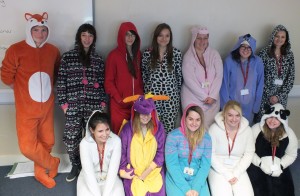
Veterinary Nursing Students in onesies raising money for Children in Need

Veterinary nursing students raising money for Children in Need in their onesies

Staff and students from The College of Animal Welfare in Godmanchester were delighted to raise £126 for Children In Need on Friday 13 November.

A variety of ‘spottiness’ was seen around the college –from spotty scarfs and spotty shirts to spotty onesies and spotty cakes!


Alison German, Marketing Executive at The College of Animal Welfare, commented: “It was lovely to see our staff and students come together to raise money for such a great cause”. She continued “We aimed to raise at least £100, so we are delighted that we managed to beat this target!”

– Ends –

For more information please contact:
Alison German RVN
Marketing Executive
The College of Animal Welfare
Email: agerman@caw.ac.uk

Notes to editors:
The College of Animal Welfare is one of the UK’s leading providers of veterinary nurse and animal care training and education; operating from four training centres around the UK.

The College has a well-earned reputation for excellence and has created a number of unique achievements that have created new opportunities for learning.

For more information about The College of Animal Welfare please visit www.caw.ac.uk

The College of Animal Welfare 2015 Teaching Awards

Has your lecturer gone above and beyond the call of duty? Are they always there to help and support you and show you ways in which you can improve? Do they make learning fun and enjoyable and inspire you to be the best you can be?

If you think your lecturer deserves special recognition please nominate them for one of the following awards:

  1. Outstanding Lecturer
  2. Outstanding Quality Assurance Supervisor (VN)
  3. Innovative Teaching
  4. Best Feedback Given
  5. Most Inspirational Lecturer
  6. Contribution to Academic Support

Nominations can be made online but hurry as they must be made by Wednesday 18 November!

Vote for your lecturer here!

There’s no need to wait until next September to start training as veterinary nurse!

There’s no need to wait until next September to start training as veterinary nurse!

Are you looking to train as a veterinary nurse? If so, there is no need to wait until next September, you could start your training in January!

The January start programme is run at our Huntingdon, Potters Bar and Leeds centres. To enrol you should be employed in a veterinary practice that is approved to train veterinary nurses, a Training Practice (TP) or Auxiliary Training Practice (aTP), and have a minimum of five GCSEs at Grade C or above in Maths, English Language and Science (or acceptable equivalent qualifications).

If you are 16-18 years of age at the start of the programme you could be eligible for full funding if undertaking the Level 3 Diploma in Veterinary Nursing as part of an Advanced Apprenticeship. And for those 19 and over we offer the option of paying for your course on a monthly direct debit basis.

Visit our website to find out more about training to become a veterinary nurse or call us on 01480 422060.

Veterinary LGBT+ Group

A British Veterinary Lesbian, Gay, Bisexual and Transgender group (LGBT+) has recently been set up and is open to anyone who wants to support LGBT rights. The group, which has been formed on Facebook, has more than 300 members.

It aims to create a friendly and social LGBT community in the veterinary and associated professions, promote equality for LGBT individuals, and provide support for those working and studying in the profession.

Over the next year the group hopes to hold social meetings, develop a LGBT network in universities and colleges, and march together at London Gay Pride 2016.

The group can be found on Facebook , Twitter or by emailing BVLGBT@gmail.com.

Animals at War

From mascots to beasts of burden, animals have been going to war with mankind throughout recorded history. Horses carried cavalrymen, pulled chariots, and their relatives the donkey, the mule, the camel, and the ox carried supplies through thick and thin. Even war elephants could be counted to put their foot down in the defence of their nation – they were taken to war as early as a thousand years BC. Did you want a message sent via air mail? No need to wait for airplanes to be invented; a carrier pigeon could take your note hundreds of miles, faster than a horse could run!

You didn’t need to be a fighter to make an impression on your bunkmates – cats, dogs, birds, and more served as pest control, search and rescue, mascots, or more! In fact, animals even have their own Victoria Cross!

Maria Dickin, founder of the People’s Dispensary for Sick Animals (Today’s PDSA) established the Dickin Medal, awarded to animals who”conspicuous gallantry or devotion to duty while serving or associated with any branch of the Armed Forces or Civil Defence Units”. Between 1943 and 1949 this award was bestowed 53 times, and since 2000, when the medal was re-established, it has been given out to 11 further deserving hairy heroes.

Here are a few of our favorites – animals who were instrumental in saving lives during wartime.

  1. White Vision, Winkie, and Tyke (pigeons)
    Pigeons were the quintessential express delivery service for the military until the end of the Second World War, and these three pigeons delivered messages from downed aircrew that led to their rescue. They were the very first recipients of the Dickin Medal, in December 1943
  2. Jet, Rip, Irma, and Beauty (dogs)
    These four dogs were awarded the Dickin Medal for their work locating people buried under bombed-out buildings during air raids in the UK. Together, they rescued over 500 trapped victims of bombing raids; they received their medals in 1945.
  3. Judy (dog)
    Judy had an adventurous war – after her ship, the HMS Grasshopper was sunk, she repaid being rescued by finding fresh water for the stranded sailors with her on a deserted island. She narrowly escaped being eaten by a crocodile, and then after her shipmates had been captured, was smuggled into one of the prison camps, where she became the only registered canine prisoner of war during WWII. Busy keeping morale up among the prisoners, She was moved from camp to camp, surviving a second sinking on board the SS Van Warwyck, before being smuggled onto an Allied troopship at the end of the war, bound for the UK. She received her Dickin medal in 1946.
  4. Simon (cat)
    Simon was the ship’s cat of HMS Amethyst. Born in Hong Kong sometime in 1947 or 1948, Simon was smuggled on board ship in Hong Kong where he established a reputation for being an outstanding ratcatcher, as well as an irrepressible cheekiness. Amethyst ran aground under fire during the 1949 Yangtse Incident during the Chinese Civil War, and Simon was badly wounded by Chinese Communist artillery fire. Recovering from his wounds, he found the ship overrun by rats, which was an enormous health risk to the ship under siege. The cat proceeded to clear the rats out during the 3 months the ship was trapped up the river, leaving dead rats as ‘presents’ to the crew. Simon (and the Amethyst) returned to a heroes’ welcome in 1949, with Simon receiving the Dickin Medal and promotion to ‘Able Seacat’. Sadly, Simon died shortly after arriving in the UK, from illness and his war wounds. Simon is still the only cat ever awarded the Dickin Medal.

For more animals that served in war, see http://www.iwm.org.uk/history/15-animals-that-went-to-war. A full list of Dickin Medal winners is available at https://en.wikipedia.org/wiki/Dickin_Medal.

Students selected to go to India

CAW VN students travel to India to train local veterinary technicians

Veterinary nursing students from Edinburgh Napier University/The College of Animal Welfare will be travelling to India in November to train local veterinary technicians to help raise the standards of care and make lasting improvements to animal welfare.

The eight student veterinary nurses will travel to Kerala Veterinary School along with two registered veterinary nurses and two veterinary surgeons. They will train the technicians in a two week workshop focussed around basic clinical techniques and low tech interventions which will make a big difference to the quality of life of animals in their care. The technicians will learn about how vet and nurses work alongside each other, hear best practices in hygiene and infection control and learn how to recognise and manage pain in animals, amongst other things.

The project will be delivered in conjunction with the Jeanne Marchig International Centre for Animal Welfare Education, with the support of The College of Animal Welfare and the Royal (Dick) School of Veterinary Studies. 

Despite the country’s ever increasing pet population, there are no officially recognised veterinary nursing qualifications in India.

You can keep track of the students’ experiences on the trip on their blog.

#WEWeek2015 – Shadow a lecturer for a day

#WEWeek2015 – Are you a vet or vet nurse and looking at your future options? Do you love supporting students and seeing them achieve? Then becoming a lecturer may be the perfect career for you!

Changing careers is a massive step for anyone to take, what will the new job really involve? Will it really be for you? When it comes to becoming a lecturer we can help. We are more than happy to offer you the opportunity to shadow one of our lecturers for the day so you can see first-hand what the job involves.

Please contact us to discuss this further.

Veterinary Nursing: The Time Between VN Qualification and Registration

The time between successfully completing your nursing qualification and receiving Royal College of Veterinary Surgeons (RCVS) registration can often be a time of uncertainty – what are you allowed to do in practice?

The answer to this question is different for diploma students and degree students and can be found in the RCVS ‘Awarding Organisation and Higher Education Institution Handbook’ Version 1, p28 – 30.

But first, the clarification of some terms…

Certification: The RCVS Certificate of Registration is issued once a student has met all the requirements of their course and requirements for certification (e.g. number of training hours completed). This certificate signifies the eligibility to register; it is not confirmation of registration.

Registration: successful entering onto the Register of Veterinary Nurses (i.e. you are now an RVN). This involves the RCVS receiving a registration application, record of employment and training, and the registration fee.

Diploma Veterinary Nursing Students

City & Guilds are an awarding organisation and perform certification themselves. They inform the RCVS of all students that have been certificated. For diploma students, the status of Student Veterinary Nurse (SVN) is retained for a period of 3 months from the point of certification. The RCVS will send each student a registration pack which will contain information on how to apply to enter the register.

After the three months, if there has been no application for registration, SVN status is removed and the person now has the status of a lay person i.e. no delegated work under Schedule 3 can be performed.

In summary, diploma students can continue to perform delegated work under Schedule 3 for a period of up to 3 months after certification.

Usually the process of registration will be completed within 4 weeks and the RCVS will contact each person directly and issue the Certificate of Registration and RVN badge. This certificate can be issued through the post or you can apply to receive these at an RCVS admission ceremony.

Application Guidance for entry to the VN Register.

Degree Veterinary Nursing Students

The situation for degree students is very different.

At the point that a degree student completes their course and is waiting to graduate, their status will change from SVN to “graduand.” From this point, the person is not allowed to perform delegated work under Schedule 3, and is classed as a lay person.

The University will inform the RCVS of all students who have completed all elements of their degree (passed all modules, completed the required practice hours, and completed the NPL) at least six weeks before the University graduation ceremony. The graduand will complete the process of registration prior to the graduation ceremony so that their Certificate of Registration can be awarded at the same time that their degree is conferred on them.

If the graduand has found employment, they can apply for Temporary Registration to the RCVS. If this application is successful, the graduand can perform delegated Schedule 3 acts under the supervision of a named veterinary surgeon. This temporary registration ends on the date of the graduation ceremony.

In summary, degree graduands cannot perform Schedule 3 acts (unless they have been granted Temporary Registration with the RCVS).


Veterinary nursing programmes at The College of Animal Welfare

Keep your knowledge and skills up-to-date with Continuing Professional Development
#WEWeek2015 – Get involved and volunteer!

#WEWeek2015 – Have you ever thought about volunteering? Volunteering gives you the opportunity to give something back to the community and really make a difference to the lives of people or animals around you. You can also gain vital experience and develop new skills, knowledge and friends!

Interested? Check out https://do-it.org – you can search for opportunities near you!

Work experience – where could it take you? We take a look at how work experience can change lives!

This week is #WEWeek2015 (Work Experience Week 2015), a week dedicated to raising awareness of the benefits that work experience can bring and celebrating the opportunities it can open up.

As part of this we caught up with our Marketing Executive, Alison German RVN, to find out how work experience shaped her working life.

What is your first recollection of work experience?

The first time I went on work experience was in secondary school; having developed a love of animals from a young age, going to a veterinary practice was a natural choice to me.

Fortunately, I was lucky enough to be accepted at a practice a few miles from where I lived. Whilst on work experience I had the opportunity to be involved in many different aspects of practice life; from cleaning cages and feeding animals to sitting in on consultations and watching operations. Once I had finished, my mind was made up that becoming a veterinary nurse was the career for me (even though I did nearly faint during the first operation I watched!).

During my time there, I discovered that the practice had a couple of evening and Saturday staff who would come in for a few hours to clean and do some of the housekeeping jobs around the practice such as taking the post, doing the laundry and restocking products in reception. I made sure the practice knew that I would be interested if one of those jobs became available. Luckily for me, a while later one did and I held this job alongside studying animal care at The College of Animal Welfare for a year.

As I came to the end of my one year animal care course I was very lucky to be offered a paid position as a student veterinary nurse at this practice. I then attended college on a day release basis for two years, qualifying in 1999 after successfully passing all my exams.

What tips do you have for anyone about to undertake work experience?

This is your opportunity to get involved and make a good impression – you will only get out what you put in!

Be grateful and show you are keen to get involved; ask questions and learn new things. It can be nerve wracking going in to a working environment for the first time but that is completely normal and you will come out a much better person for it.

Hopefully as my story will demonstrate, if you make a good impression, who knows where it could lead. For me it was a job and a career, it could be the same for you!

Take a look at animal care and veterinary nursing courses at The College of Animal Welfare.