Author Archives: Alison German

Veterinary Care Assistants Offer Reduces Down

We have had a great response from practices to our free Level 2 Diploma for Veterinary Care Assistants (VCA) training offer over the past few months, with over 150 new students now signed up and working towards the qualification.

As of the end of May, practices are still able to access funding for the course fees for eligible students (those aged 19 or over who are employed in a veterinary practice* in England) but will be required to pay the £174 awarding body fees from now until 31 July 2012. After this time full course fees and awarding body fees are payable.

To take advantage of the remaining funding availability please apply online or call us on 0844 372 9410.
* The employer must have less than 250 employees

Bugs! Bugs! Bugs!

We would be very grateful for any examples of parasites mounted on microscope slides. We have a diminishing supply of these and additional examples would help with revision and study sessions. Any ‘donations’ would be greatly appreciated.

Please ensure that any ‘exhibits’ are securely mounted and sent to Tamsin Swain at our Potters Bar centre or, alternatively, handed in at any of our centres. Thank you!

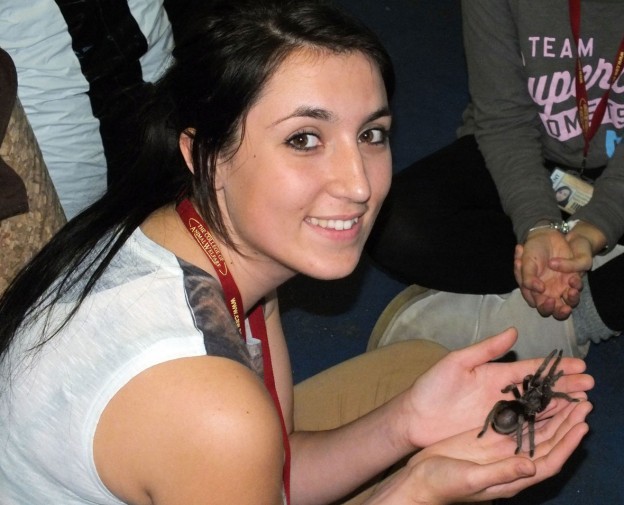
Female student with spider

Advanced Apprenticeship in Veterinary Nursing (Level 3 Diploma) – Enrolling Now for September!

If you have a member of staff looking to start their veterinary nurse training this September then don’t delay, enrol them now as places are filling up fast. Remember if the potential student is waiting for exam results this Summer they can still enrol now, and if for any reason they are unsuccessful and do not get the required grades your practice will get a full refund.

Potential students can request log in details to enrol by clicking here, choosing the ‘Course Applications’ Button and submitting their details. They will then receive full enrolment instructions by email.

Free Work-Based Animal Care Training – Just 8 Weeks Left!!

We have been delighted that animal welfare organisations and kennels & catteries throughout England, have chosen to enrol their staff onto our animal care apprenticeship programmes over the past few weeks.

There are now just eight weeks left to take advantage of nationwide free animal care apprenticeship training for animal care staff. Remember apprenticeships incorporate the City & Guilds Diploma in Work-Based Animal Care (formally NVQ) and are not just for new members of staff; people with varying levels of experience may choose to undertake an apprenticeship to consolidate their skills and knowledge into a formal qualification. The level 2 qualification is suitable for all members of the animal care team whilst the level 3 qualification is aimed more at supervisors and team leaders.

The training can be started at any time and there is no need for students to attend College as support will be provided by an allocated college assessor who will keep in touch by phone, email and regular visits to your place of work.

In order to qualify for free apprenticeship training, staff must be employed for a minimum of 30 hours per week and cannot already hold a Level 4 or Higher Education qualification i.e. degree. Unfortunately funding is only available in England.

Free Apprenticeships in Horse Care and Customer Service are also available during this time period.

For further information please contact us.

Get involved in National VN Awareness Month – July 2012

If you are a veterinary nurse and are passionate about your profession then why not get involved with this year’s ‘National Veterinary Nursing Awareness Month’ which runs from the 1-31 July?

Help promote the importance of the veterinary nursing profession and educate the general public about the different roles of nursing staff in practice by organising an event such as a practice open day or enter the photo competition; there are some great prizes on offer!

Category A | Best Community Event ‘Raising awareness of the role of the veterinary nurse’
Prize: Laptop & runner-up prize Kindle kindly sponsored by ‘VN Times’

Category B | Best Careers Event ‘Promoting a career in veterinary nursing’
Prize: Apple iPod Touch & runner-up prize £100 high street vouchers kindly sponsored by ‘Royal Canin’

Category C | Best Photo ‘A veterinary nurse working above and beyond the call of duty’
(The winning photo will be used as a visual for the 2013 Poster)
Prize: Digital Camera & runner-up prize Pocket Camcorder kindly sponsored by ‘Protexin Veterinary’

For a free events pack please contact the British Veterinary Nursing Association (BVNA) on 01279 408644 or register online via www.bvna.org.uk

Common Areas of Failure During the Recent RCVS OSCE Examinations

Feedback on the recent Veterinary Nursing OSCE Examinations can be found below. Please ensure you and your students are familiar with this guidance:

Laboratory
Many students failed to mix the urine and reading the Refractometer and Multistix correctly are a cause for concern. The blood smear should be left vertically to dry and when placing a slide onto the mechanical stage of the microscope the label should be to the left. It is also important to label any slide used with the chinagraph pencil .

Nursing care
Throughout these tasks the hospitalisation sheet was not completed fully or correctly. Needles should be changed prior to injection into the animal, which should all be restrained for any procedure. Needles should never be re-sheathed. We strongly recommend that there is plenty of practice in the calculation and dispensing of medication as poor results were seen for the dispensing task during its debut in March. It is vital that the candidate seek approval for the dispensed medication from the examiner to meet the recommended guidelines.

When bandaging it is important to ensure that the tension is correct and that the bandage includes the joints both above and below the affected area. The animal should be positioned with the injured limb uppermost and assistance should be sought to facilitate this.

Whilst administering the tube feed it is vital to give the correct volumes of food and water slowly. The required calculation is based on feeding charts supplied with each food choice and the requested number of daily feeds. All equipment should be disposed of correctly on completion.

The urinary catheter task requires that you dispose of the urine correctly – this must be done whilst still wearing the gloves for health and safety reasons. Correct methodology must be observed for the calculation of the daily expected urine output.

The new Fluid Therapy task caused problems for many students who ran out of time. It is vital that students work with the figures they are given on any hospital chart and not try to recalculate figures. Prior to the exams there should have been plenty of practice in working out drip rates – this is particularly important for students who are regularly using drip pumps in Practice.

Anaesthesia
Students must ensure that the APL valve is left fully open on completion of the task. All circuits should now be leak tested. Only the mini-lack task requires that the flowmeter be set to the calculated Fresh Gas Flow.

Theatre Practice
When packaging the drape it is important to remember that a TST strip must be placed into the middle of the drape. The quantity must be recorded on the outer packaging in addition to the date of sterilisation and the initials of the candidate

All calculations must detail not only the correct units but also the time.

Ineffective WHO hand hygiene technique lead to failures on both the urinary catheter and blood sample tasks, ensure this has been fully practised following the key steps so as to avoid any unnecessary errors.

Follow us on social media to be the first to see our latest OSCE updates, tips and advice: [ss_social_follow networks=”facebook;twitter;instagram;pinterest”]

RCVS to Continue Processing Student Veterinary Nurse Enrolments

The Royal College of Veterinary Surgeons (RCVS) have confirmed that student veterinary nurse enrolments will continue to be processed by them:

“The RCVS will continue to enrol students for the purposes of keeping a record of those entitled to undertake Schedule 3 work. Enrolment will, as now, be the commencement of a student’s eventual professional record. We will manage processes directly with centres (rather than awarding institutions) as we currently do””

Enrolment forms can be downloaded from the RCVS website here.

New Radiology Revision App for Veterinary Nurses

The British Veterinary Nursing Association (BVNA) has joined forces with leading IT provider, AT Veterinary Systems, to produce a handy radiology revision app for veterinary nurses.

Split into two sections, the app comprises a quick revision and a full revision option. The quick revision is a spot test of twenty multiple choice questions with a time limit for each question. Each score is recorded on the scoreboard, allowing you to compete with yourself to get better and better.

The second section is a quiz of sixty questions that you can answer at your leisure, ensuring you learn all you need to know about the use of radiology in the veterinary practice.

Example:
Q. Is collimation:
a) One method of assessing the radiograph
b) Superior if a light beam diaphragm is used rather than a cone
c) Essential when using non-manual restraints
d) Monitored by the use of TLDs

All 125 questions are randomly generated to reinforce every aspect of the subject in your mind and the layout makes it quick and easy to use.

If you are a veterinary nurse in training, perhaps with approaching exams or maybe simply wanting to test and refresh your knowledge, then this app is perfect for you.

Visit the Apples Store here for more information.

Disagreeable People Prefer Aggressive Dogs

A study carried out at the University of Leicester’s School of Psychology has found that younger people who are disagreeable are more likely to prefer aggressive dogs, confirming the conventional wisdom that dogs match the personality of their owners.

Researchers found that low Agreeableness was the best predictor of a preference for those dogs seen as more aggressive, such as bull terriers or boxers. Individuals low in Agreeableness are typically less concerned with others’ well-being and may be suspicious, unfriendly and competitive.

However, the study found no link between liking an aggressive dog and delinquent behaviour, or the possibility that liking an aggressive dog is an act of ‘status display’ to show off or attract romantic partners.

Dr Vincent Egan, lead researcher on the study, said: “This type of study is important, as it shows assumptions are not the whole picture. It is assumed owners of aggressive dogs (or dogs perceived as aggressive) are antisocial show-offs. But we did not find persons who expressed a preference for aggressive dogs had committed more delinquent acts, or reported showing off more.

“However, we did find a preference for a dog with an aggressive reputation was related to being younger and being lower in Agreeableness (i.e., being less concerned with the needs of others, and being quicker to become hostile).”

The study looked at the reasons why some people prefer aggressive dog breeds. Professor Egan explained: “A lot of human behaviour involves status display and dominance, and evolutionarily this helps with finding mates. Basic personality also influences a lot of our behaviour. By measuring both at the same time, we could see whether they each had an influence on liking aggressive dogs, or whether one was due to another.

“We were surprised mating effort did not have an influence here, but think it might be because we looked at a wider age range. A preference for a non-aggressive dog may also make a statement about a person; liking a pedigree Labrador or a clipped Poodle may be as much a statement as having a pit-bull with a studded collar.”

In the study, participants indicated their preference for different types of dogs, and filled in personality tests. The dogs were independently rated according to how aggressive people perceived them to be. Bull terriers were rated as most aggressive, followed by boxers; retrievers and cocker spaniels were seen as least aggressive.

Analysing the findings, the research team found that certain personality factors indicated a preference for dogs perceived to be more aggressive. Low agreeableness and higher conscientiousness were related to a preference for aggressive dog breeds. Younger people were also more likely to prefer the aggressive breeds.

Surprisingly, the results indicated a small effect suggesting that those who liked aggressive dogs showed signs of conscientiousness – being careful, reliable and thoughtful about their actions. This contradicts the perception that owners of aggressive dogs are always irresponsible.

Dr Egan said: “These results with Conscientiousness were unexpected, but the effect is a small one, and needs to be repeated in a different group of people. Studies of this kind tend to only look at a restricted age ranges, which may exaggerate findings which do not occur across the entire lifespan, so we believe a stereotype is always true, whereas it may only be true under certain conditions. Our study employed a broader age range.

“We were surprised to find a small association between a preference for aggressive dogs and greater Conscientiousness (i.e., valuing and following rules). However, dogs also prefer rules and firm boundaries themselves. We speculate that cheap dog-training classes would be enjoyable and beneficial for both dog and owner.”

The findings were published last week in the journal Anthrozoos.
Veterinary Care Assistants Free Training – Just 9 Days Left!

Don’t miss out!

There are just 9 days left to take advantage of the fully funded (ie FREE!) Level 2 Diploma for Veterinary Care Assistants (VCA) training.

‘We have been delighted with the response from practices taking up the full funding offer over the past few months’ commented Leslie Heaton-Smith of The College of Animal Welfare, adding ‘but unfortunately the funding cannot last forever and will reduce down from the end of this month.’

Any practice enrolling their student after this time will continue to receive funding for the course fees but will be required to contribute towards the cost by paying the awarding body fees of £174. After July the funding for this year will have been used up and then it’s back to full course and awarding body fees of £1039 applying.
Veterinary practices do not have to be an RCVS Training Practice to train their veterinary care staff using this nationally recognised qualification. The course is taught completely online so College attendance is not required. Students can start at any time and should aim to complete the award within 12 months. The VCA programme can also, in combination with GCSEs at Grade C or above in English Language and Maths (or equivalent), allow progression onto the Level 3 Diploma in Veterinary Nursing programme.

Please note that the funding is only available for students, aged 19 or over, who are employed in a veterinary practice* in England.

To take advantage of full funding, enrolments must be received by the 31 May 2012.
Further details on the VCA programme can be found here.

* The employer must have less than 250 employees.