
VetSkill VTEC Level 2 Certificate in Assisting Veterinary Surgeons in Monitoring Anaesthetised and Sedated Companion Animals
Start dates
Start at any time
Location
Anywhere in the UK or overseas. Overseas students must act in accordance with the legislation of the country in which they are participating in veterinary procedures.
Duration
12 months
Formats
Online learning with tutor support
Why choose us?
 Disability Confident Committed EmployerMatrix Standard - Demonstrating the provision of quality Information, Advice and GuidanceOfqual regulated qualificationsDedicated learning support team
Overview
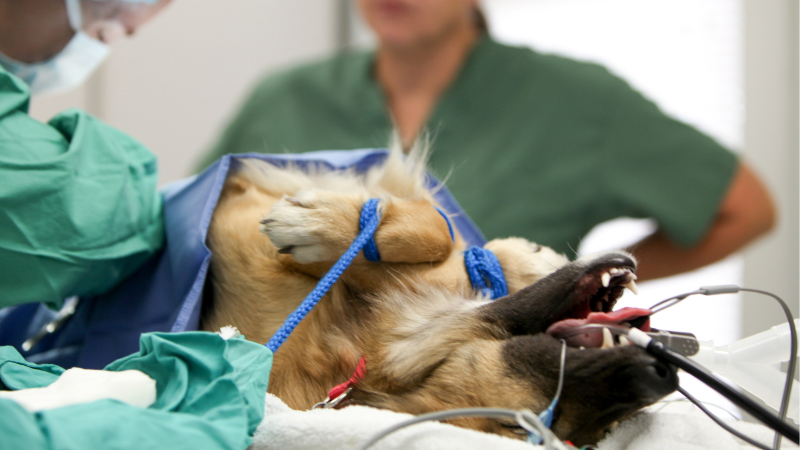
This qualification has been designed for those working in a veterinary care assistant role in practice that might be called upon to assisting veterinary surgeons with the monitoring of companion animals under anaesthesia and sedation.
Whilst it is recognised that the monitoring of anaesthesia of companion animals is best carried out by a qualified veterinary surgeon or veterinary nurse, this is not always possible in every circumstance. It is therefore important that lay staff, who may be called upon to assist, are equipped with the necessary knowledge and skills needed to do so in a safe, professional manner.
Under no circumstances will the learner be inducing, controlling or maintaining the level of veterinary anaesthesia of companion animals as this is, without exception, the responsibility of the veterinary surgeon. All anaesthetic monitoring must be carried out under the direct supervision of a veterinary surgeon in accordance with veterinary instructions and current RCVS guidance. Learners may not legally perform any action either during their training, or post-qualification, which may be interpreted as an act of veterinary surgery as defined by the Veterinary Surgeons Act 1966.
Course details
What will you study?
- Legal and ethical responsibilities including the Veterinary Surgeons Act 1966, RCVS Guidance and health and safety.
- Anatomy and physiology of the cardiorespiratory system including key structures and function, gaseous exchange and oxygenation of tissues.
- The principles of sedation and anaesthesia including common terminology, routes of administration, pre-medication, protocols, clinical observations, the stages of anaesthesia, key drug groups.
- Anaesthetic equipment including the safe use of, maintenance and common faults.
- Patient preparation including standard operation procedures, admission procedures, consent and health checks.
- Assisting with the monitoring of companion animals under anaesthesia and sedation including vital signs, record completion and monitoring devices.
- Assisting with the recovery from anaesthesia and sedation including accommodation, positioning, monitoring, handover to colleagues and complications.
- Anaesthetic emergencies including emergency boxes, equipment failure and resuscitation procedures.
Assessment
You will compile a portfolio of evidence, log 200 hours of practical experience assisting vets with the process of sedation and anaesthesia, and undertake an online multiple-choice examination.
Start dates
Our online, distance learning courses can be started at any time. You will work through your online course materials at a time that is convenient to you and be supported by a personal tutor.
Entry requirements
There are no formal academic entry requirements, however you should:
- Be employed, or volunteering, in a clinical role in a veterinary practice and have the support of your practice to undertake the course.
- Have your application endorsed by your Practice Principal (who must be a veterinary surgeon – MRCVS) and have a veterinary surgeon in your practice who is happy to supervise you throughout your course.
Fees and funding
- £1,825 – UK students
- £2,555 – Overseas students
Awarding Body Fees - £179
All students or employers are required to pay the awarding body fees in addition to the course fees. Please note that these are recharged at cost and may be subject to change.
CAW Loans2Learn
Course fees must be paid in full before the course begins. If you are unable to do so, we offer a personal loan scheme (Loans2Learn) that can help you to spread the cost into manageable monthly payments over a period of up to five years, subject to eligibility. It can be used to fully, or partially, cover your course fee (but does not cover any awarding body fees, such as enrolment and examination fees which are payable on top). More information can be found here.
LOAN CALCULATOR
 The current rate of interest for a CAW Loans2Learn is 9%. Click on the calculator icon to calculate your monthly repayment options based on different repayment term lengths.
Example repayment - a Loans2Learn loan for the full UK course fee of £1,825 over 24 months would equate to monthly repayments of approximately £83 per month (please note this is an indicative price based on current fees and interest rates).
General Advice
Sources of financial help can be found on our student finance page. Before making any financial decision it is recommended that you seek advice from an independent source, for example the Money Advice Service.
If you have not achieved your qualification by the planned end date detailed in your individual learning plan, continued support and course access is available by paying monthly direct debit payments, or applying for a supplementary or increased loan, until certification is achieved.
These are current figures and may be subject to change. The differences in course fees reflect the level of funding that is available as a result of government policies and priorities. These may be as a result of age, employment status, previous education achievements, or location for example, and are outside the control of The College of Animal Welfare.
Your future
Ideally the monitoring of companion animal anaesthesia should be carried out by a qualified veterinary nurse under supervision of a veterinary surgeon, and as such, training to become a veterinary nurse is something you may wish to consider in the future by undertaking the Level 3 Diploma in Veterinary Nursing programme if you have the required qualifications for entry.
Alternatively, if you do not wish to train as a veterinary nurse but undertake further qualifications in veterinary are, you may consider undertaking either the Level 2 Diploma for Veterinary Care Assistants or the Level 2 Certificate in Veterinary Care Support programme. These qualifications are also delivered by online, distance learning.
brochure Open days Similar
courses
Course highlights / facilities
 Access to our Virtual Learning Environment
 Experienced distance learning tutors
 Access to our extensive eLibrary
 Accredited by VetSkill
Frequently asked questions
Do I need to already work in a veterinary practice before applying?
You don’t need to be in paid employment in a veterinary practice to do the course, but you do need to be working as part of a practice team; this can be done through volunteering.
Does the veterinary practice I work for need to be an RCVS approved Training Practice (TP)?
No, there is no need for the practice you are working/volunteering in to be a TP.
I am 16 years of age, is this course free?
No, as a private further education college fees are applicable to all students. We do, however, have a Loans2Learn scheme that can help you to spread the costs of study into manageable monthly payments.
Ready to enrol?
Create an account and start your application today.
Full Course Brochure
Enter your details to download the full course brochure. We'll email you with information about the course.
You can unsubscribe at any time. We respect your privacy and handle your data with care. Please see our privacy policy.