
FdSc Veterinary Nursing (Royal Veterinary College)

Start dates
September
Location
The Royal Veterinary College, Potters Bar
Duration
Three years
Formats
Full time
Overview
This three year, full-time course is delivered and awarded by the Royal Veterinary College (University of London) with support from The College of Animal Welfare.
The course provides the unique opportunity to study towards a foundation degree in veterinary nursing at the UK’s largest and oldest veterinary school. Throughout the qualification you will undertake clinical practice placements at veterinary practices, which will be arranged for you by The College of Animal Welfare's placement liaison team.
The Royal College of Veterinary Surgeons (RCVS) has given direct accreditation to this programme, meaning graduates will be able to apply to join the RCVS Register of Veterinary Nurses in accordance with the requirements of the Veterinary Surgeons Act (1966) and the RCVS Veterinary Nursing Registration Rules. It is by means of RCVS registration that vet nurses achieve their highly valued professional status.
Students on this course come from all different backgrounds and countries, but all share the common goal of wanting to succeed in the veterinary field and help contribute to animal welfare and health.
Course details
What will you study?
You will cover the following units:
Year 1:
- Professional Development and Clinical Skills 1
- Clinical Nursing Practice 1 & 2
- Veterinary Nursing Applied Science 1 & 2
Year 2:
- Professional Development and Clinical Skills 2
- Emergency, Critical Care Nursing and Anaesthesia
- Diagnostic Techniques
Year 3:
- Professional Development and Clinical Skills 3
- Applied Nursing Care
- Professional Practice
Clinical experience
During the programme you will spend time gaining practical experience in RCVS approved veterinary practices. You will be offered the opportunity to choose between placements near to the campus that you are studying at, or near to your home where possible (potentially a considerable cost saving). We have a dedicated Placement Team who will arrange the placements for you.
Assessment
You will undertake written and practical assessments and examinations.
Start dates
Intake are in September.
Entry requirements
Offers for places on this programme are competitive. Admissions tutors consider all applications carefully on their individual merits.
A list of acceptable entry requirements (both academic and work experience) can be found on the Royal Veterinary College’s website.
Work experience
It is important that you ensure you have an understanding of the veterinary nursing profession and are confident this is the career for you. As such all candidates are required to provide evidence of a minimum of two weeks’ work experience in a veterinary practice and at least two weeks’ experience in a variety of different animal environments (outside of your home environment) before commencing the programme.
Fees and funding
More information regarding fees can be found on the Royal Veterinary College’s website.
Your future
Registering as a newly qualified registered veterinary nurse (RVN)
On completion of the Foundation Degree in Veterinary Nursing, you will be eligible to apply to join the RCVS Register of Veterinary Nurses. Once on the register, you will be able to call yourself a Registered Veterinary Nurse and use letters RVN after your name.
Progression and employment prospects in veterinary nursing
As a result of a high demand for registered veterinary nurses across the country, job prospects are excellent both within veterinary practice and in other related areas. Salary prospects have improved significantly in recent years, the median salary package for qualified veterinary nurses is now £30,500 (SPVS Salaries Survey 2022/3).
There are many opportunities for graduate veterinary nurses, from working in first opinion veterinary practice to moving into more specialist areas, such as surgical nursing in a referral practice or large veterinary hospital. On completion of degree level training and study, your career prospects could also expand into team leadership, research, teaching, sales or rehabilitation.
Alternatively, you may wish to ‘top up’ your foundation degree to a full BSc (Hons) Veterinary Nursing qualification by undertaking the BSc Top Up degree programme offered by The College of Animal Welfare and Middlesex University.
courses
Course highlights / facilities
 Clinical Skills Training
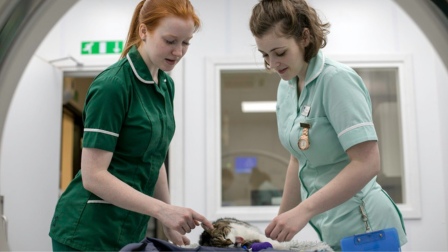 Work placement in veterinary practice
 Leads to RVN Registration
 Awarded by the University of London
Frequently asked questions
Are the placements paid or unpaid?
All work placements are unpaid as they form part of your training and are required to meet professional standards.
Ready to enrol?
Create an account and start your application today.