
BSc Honours Veterinary Nursing Degree (Middlesex University)
Start dates
September
Location
Middlesex University, Hendon (North London)
The College of Animal Welfare, Huntingdon (Cambridgeshire)
The College of Animal Welfare, Leeds (West Yorkshire)
Duration
Four years
Formats
Full time
Why choose us?
 Awarded by Middlesex University
 Matrix Standard - Demonstrating the provision of quality Information, Advice and Guidance
 Royal College of Veterinary Surgeons Approved
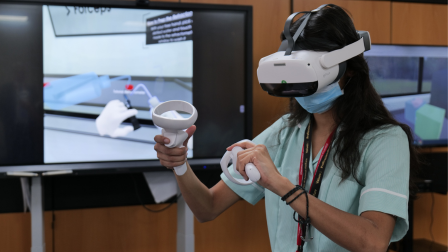 Free access to virtual reality
Overview
Webinar: Veterinary Nursing Courses at CAW - Wednesday 2 December 2026, 7pm-8pm. Book a place here.
Middlesex University Voted Number 1 in the UK for Veterinary Nursing (National Student Survey 2024 and 2025)
This programme is a joint initiative between The College of Animal Welfare, and Middlesex University. It was the first degree of its kind in Europe.
The degree is a single award from Middlesex University and was the first programme in the UK to be given direct accredited status by the Royal College of Veterinary Surgeons (RCVS). This means that unlike those training on non-directly accredited programmes, graduates will not need to undertake further assessment in order to be eligible to apply to join the RCVS Register of Veterinary Nurses.
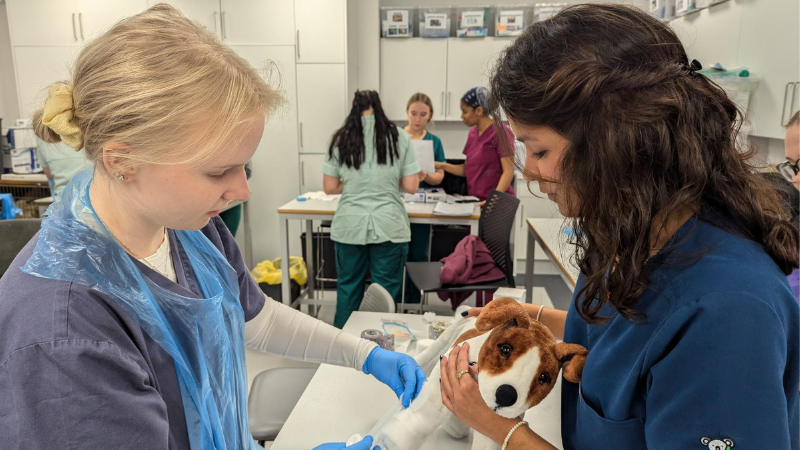
As well as modules covering relevant theoretical knowledge, there is an emphasis on gaining direct experience in veterinary practice throughout the programme. You will be encouraged to experience not only first opinion practice, but also veterinary referral centres and leading animal welfare clinics and hospitals. The practical training offers valuable opportunities to gain hands on practical experience in veterinary practices that have been carefully selected and arranged for you. This will prepare you for the responsibilities that come with being a Registered Veterinary Nurse on graduation.
Please note that regardless of whether you choose to study at Hendon, Huntingdon or Leeds, the programme delivery, structure, and assessment is the same for all students.
What do our students say?
Course details
What will you study?
All modules are compulsory and taught in three semesters per year.
Year 1:
- Body Systems (Gastrointestinal and Integument)
- Professional Development (Legal & Professional)
- Fundamentals of Working in a Veterinary Environment
- Practical Veterinary Nursing (Placement and Clinical Skills)
Year 2:
- Body Systems (Urogenital & Theatre Practice)
- Body Systems (Musculoskeletal, Endocrine and Radiography)
- Professional Development (Evidenced-based Veterinary Nursing, Communication & Ethics)
- Practical Veterinary Nursing (Placement and Clinical Skills)
Year 3:
- Body Systems (Neurology & Anaesthesia)
- Body Systems (Cardiovascular & Respiratory)
- Professional Development (Leadership skills, Wellbeing, Minor Surgical Procedures)
- Practical Veterinary Nursing (Placement and Clinical Skills)
Year 4:
- Applied Emergency & Critical Care Veterinary Nursing
- Contemporary Veterinary Nursing (Including SQP)
- Professional Development (Quality Improvement Project Proposal)
- Practical Veterinary Nursing (Placement and Clinical Skills)
Suitably Qualified Persons (SQP) - This degree programme also incorporates the VetSkill Suitably Qualified Persons (SQP) qualification, which allows graduates to join the VetSkill SQP register and prescribe and supply certain veterinary medicines.
Clinical experience - During the programme you will spend time gaining practical experience in RCVS approved veterinary practices. You will be offered the opportunity to choose between placements near to the campus that you are studying at, or near to your home where possible (potentially a considerable cost saving). We have a dedicated Placement Team who will arrange the placements for you in accordance with the RCVS Veterinary Nursing Registration Rules.
Virtual Reality (VR) - You will be loaned a free virtual reality headset for the duration of your programme that will allow you to use our two exclusive software programmes. The OSCE preparation software will help you to prepare for your OSCEs (practical exams) by creating muscle memory and alleviating exam anxiety. You can practise the OSCE tasks that you may come across in your real exam, such as taking x rays, packaging samples and identifying parasites. Our anatomy software allows you to explore and learn body systems in details. We are the first veterinary nurse college to use virtual reality and we are very excited about the potential application of it.
Assessment
You will undertake practical and written assessments, and examinations.
Start dates
Intake are in September.
Entry requirements
Academic requirements
Offers of places are given through a process of initial application, academic assessment, and interview. Admission tutors look favourably on applicants who show a commitment to pursuing a career in veterinary nursing and can demonstrate a caring and professional approach towards their work.
You should have a minimum of 5 GCSEs at grade C or above (9-4) in English, Mathematics, one Science plus two other subjects, and also hold a minimum of one of the following (or equivalent):
- A level – CCC – including a science subject (preferably Biology)
- Pearson BTEC Level 3 National Extended Diploma – MMM – in a related subject
- A recognised Access to HE Diploma – 45 credits at level 3, 15 of which must be at Merit or higher in a science or health related subject with an overall pass.
Mature students
Prospective applicants who are over 21 years of age and meet the GCSE requirement but do not hold further qualifications and are able to show high levels of ability and experience within the veterinary care sector (evidenced by a supportive reference by a Veterinary Practice Principal or Registered Veterinary Nurse), are also invited to apply.
International Students
We welcome applications from international students looking to undertake veterinary nurse training here in the UK. Applicants holding international qualifications are required to have all international qualifications officially translated into English with a notarised stamp. Furthermore, they must have proof of competence in the English Language by holding either the ESOL qualification or IELTS at a minimum score of 6.5 (with a minimum of 6.0 in all four components) where the qualifications were not taught and assessed in English, plus equivalent qualifications in the Sciences.
Work experience
Gaining at least two weeks’ work experience in a veterinary practice will be a distinct advantage for your application. However, any animal related or customer focussed work experience will be considered by admissions tutors, such as experience in kennels/catteries, zoos, rescue centres, equestrian centres, farms, pet shops, dog groomers, care work with humans and customer focussed work experience.
Additional Information
As our courses include online learning components, students are required to have access to a PC or laptop with a reliable internet connection.
Fees and funding
More information regarding fees can be found on the Middlesex University website.
Your future
On completion of the Middlesex University BSc Honours Veterinary Nursing Degree, you will be eligible to apply to join the RCVS Register of Veterinary Nurses. Once on the register, you will be able to call yourself a Registered Veterinary Nurse and use letters RVN after your name.
Progression and employment prospects in veterinary nursing
As a result of a high demand for registered veterinary nurses across the country, job prospects are excellent both within veterinary practice and in other related areas. Salary prospects have improved significantly in recent years, the median salary package for qualified veterinary nurses is now £30,500 (SPVS Salaries Survey 2022/3).
There are many opportunities for graduate veterinary nurses, from working in first opinion veterinary practice to moving into more specialist areas, such as surgical nursing in a referral practice or large veterinary hospital. On completion of degree level training and study, your career prospects could also expand into team leadership, research, teaching, sales or rehabilitation.
brochure Open days Similar
courses
Course highlights / facilities
FREE loan of a VR headset
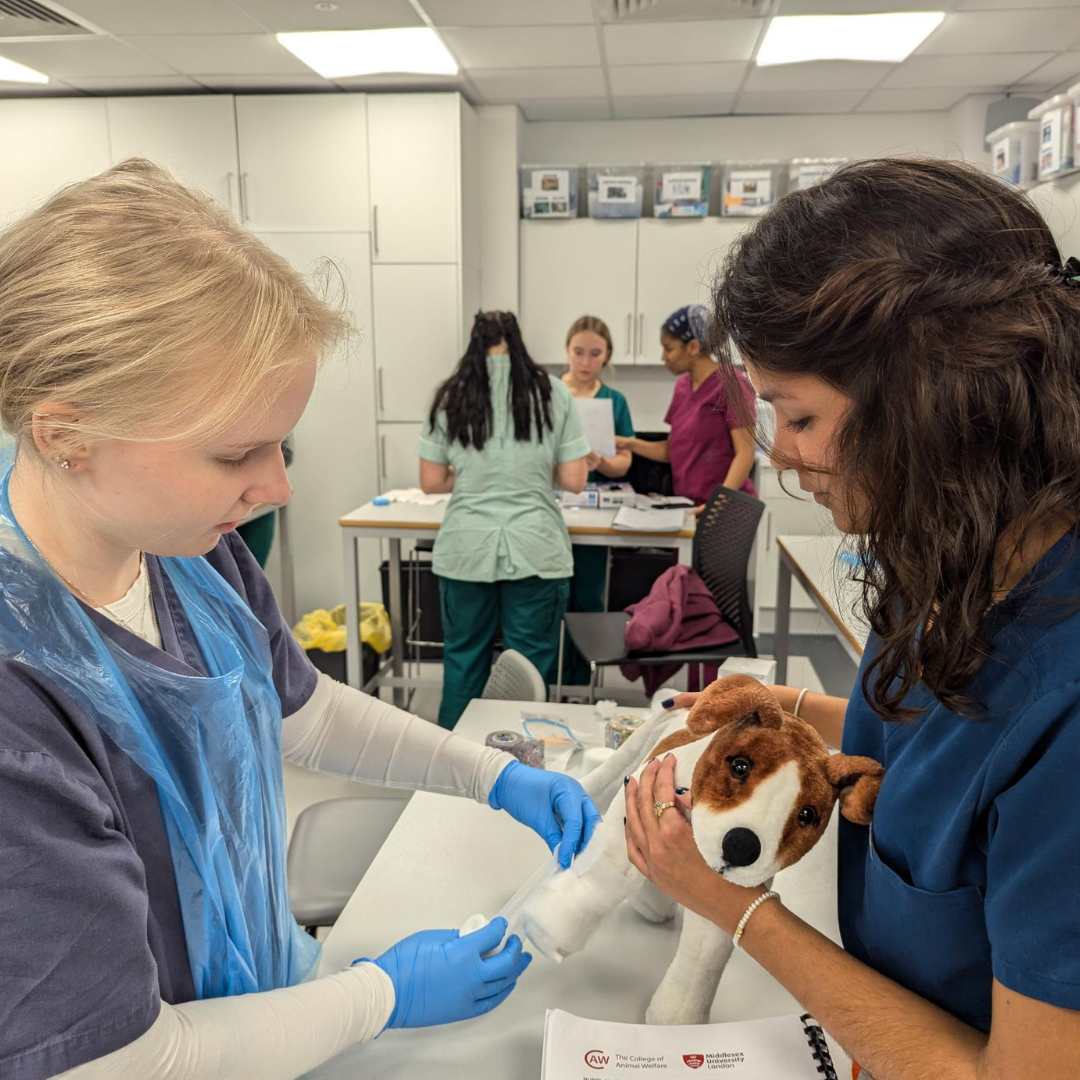
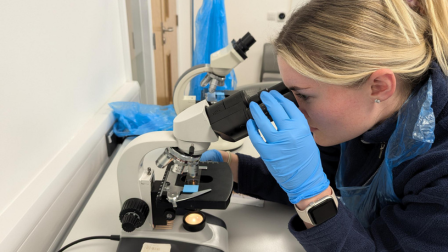 Clinical Skills Training
 Access to our extensive eLibrary
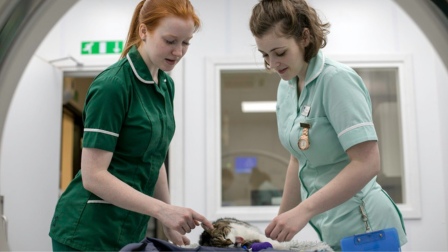 Work placement in veterinary practice
Course gallery
Frequently asked questions
How many days during the week do I have to attend uni for lessons?
You will attend uni for lessons for three days a week during the theory blocks. During the placement blocks you will work in the practice on a full-time basis.
Can I work part-time whilst studying?
It may be possible during the theory blocks at uni, but it can be challenging alongside balancing college lessons, academic study and preparing for assessments. When undertaking your placement blocks, additional work is not possible as your placement hours will be full-time and flexible to suit the needs of the veterinary practice.
Are the placements paid or unpaid?
All work placements are unpaid as they form part of your training and are required to meet professional standards.
Is there accommodation at each of the centres?
There is accommodation at Hendon and Huntingdon (subject to availability). Whilst we don’t have our own accommodation at our Leeds centre, there is plenty of student accommodation in Leeds and we can help to advise you on how to source this.
Ready to enrol?
Create an account and start your application today.
Full Course Brochure
Enter your details to download the full course brochure. We'll email you with information about the course.
You can unsubscribe at any time. We respect your privacy and handle your data with care. Please see our privacy policy.