Author Archives: Amber Tennant

Shaping the Dog Groomers of Tomorrow: CAW Grooming School one year on…

It has now been just over a year since we opened our dog grooming school at our education and training centre near Leeds. Having already successfully set up a grooming school at our head office in Cambridgeshire in 2009, the purchase of Leeds-based commercial pet centre, Campus Vets and Pets, in 2015 presented us with the ideal opportunity to offer City & Guilds accredited training to those looking to pursue a career in dog grooming in the north.

On Monday 18 April 2016, we welcomed our first two students, Jade and Victoria on the City & Guilds Level 2 Certificate for Dog Grooming Assistants intensive five week block course. Both Jade and Victoria passed their qualification with flying colours and returned a few weeks later to undertake the Level 3 Certificate in Introductory Dog Grooming; an indication of the success that has followed the grooming school ever since.

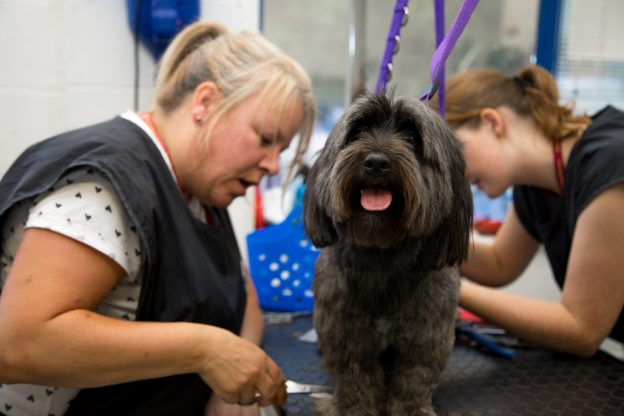
Of course, where there are students, there must be dogs… And so, alongside the launch of the grooming school, was the opening of the dog grooming salon at Campus Vets and Pets. The money generated from the grooming courses has allowed the cost of dog grooming services to be offered at an affordable level to dog owners throughout the local community; a combination that supports our ethos of raising standards of animal welfare. Initially, in order to build up the client base needed to run the grooming courses, the salon offered each dog a free groom for their first visit, with a further opportunity for a free groom if they recommended a friend. With local advertising, social media campaigns, and the excellent work of the dog grooming team and students, the word quickly spread; bringing us to today where there is a six week wait for an appointment. The low cost of grooming has encouraged owners to rebook visits to the salon on a more frequent basis, a win-win situation all around for the dogs, owners and students alike.

Dog Groomer and Practical Skills Trainer, Michelle Saunders, has been the lead trainer at the grooming school since its inception in early 2016. With over 25 years of experience in the industry prior to joining the College, Michelle was drawn to the role to share her grooming knowledge and inspire groomers of the future, ‘Dog grooming is a fundamentally practical profession and the training programme at the College reflects this; we use our facilities to help equip up and coming groomers with all the necessary skills needed to maintain and exceed industry standards’ She continued ‘Spending so much time working in the grooming salon with a wide variety of dogs makes the transition between training and work seamless’.

Opportunities to train with us are met with high competition, and demand shows little sign of slowing. The level 2 and 3 City & Guilds certificates are run on either a five week intensive block, or a six month day release basis. Students come from all walks of life; some wishing to train to change career or get back into employment, and others who are already working in the industry looking to gain formal recognition of their skills and experience.

One such student is Alisa Youngman. Alisa, owner of Alisa Lyn Youngman Dog Grooming Services based in Beverley, set up her own business post training. As well as modern facilities and supportive tutors, Alisa credits an emphasis on practical work as one of the many benefits of formal training with us. She said: I found [CAW Grooming School] such a great place to train, everyone was so welcoming and the staff were extremely knowledgeable and helpful. The course was perfect for me as it was a block course meaning I was hands on grooming full time for 10 weeks. Overall, I would qualify quickly and have a good amount of experience and knowledge behind me to confidently set my own business up – which I have and it’s really taken off! The intensity really aided my confidence and I felt I had a lot of opportunities to work with different breeds more regularly.”

The early success of the grooming school raises questions as to how the training provision will continue to grow in years to come. In response to the increasing need for varied, flexible learning opportunities; among many planned developments include the launch of the Level 3 Diploma in Professional Dog Grooming, to be run at the school on a day-release basis from September 2017. We are also looking for an additional Dog Groomer and Practical Skills Trainer to join our team in Summer 2017 to keep up with the expansion. See the vacancy 

Speaking about the future, Michelle is excited at the prospect of continuing to teach at the grooming school. “I have no doubt that we will continue to grow as awareness increases further and new services begin to open at the centre. Training has never been so important and accessible; through recognised training and experience, we can increase the recognition of the vital work that dog groomers do on a daily basis to members of the public and drive the profession forward’.

If this year acts as a benchmark for future success, then we can only expect good things to come from the grooming school. One thing is for sure: it is shaping the dog groomers of tomorrow: one paw at a time.

CAW Grooming School is based at Campus Vets and Pets (www.campusvetsandpets.co.uk), the ambitious expansion of animal welfare training provider The College of Animal Welfare. A new and modern animal welfare and training hub, the centre will eventually host a state-of-the-art veterinary practice, boarding kennels and cattery, animal physiotherapy, hydrotherapy and dog training classes. Further information on the College’s dog grooming courses delivered by CAW Grooming School can be found at www.caw.ac.uk/dg

Originally published in the July 2017 edition of Total Grooming Magazine.

Health and Fitness Tips of the Month: August

Health and Fitness Tips of the Month: August

Meditation

We have all heard that meditation reduces stress however it is now being recommended by doctors that it can help improve creativity, improve sleep, decrease anxiety, depression, eating disorders, and even addiction.

So how do we meditate?

  1. First, find a comfortable place where you can sit without distractions for at least 2 minutes and build up to 15 minutes.
  2. Sit comfortably with your back upright with head up.( Imagine your head is being pulled up to the sky)
  3. Close your eyes and focus within.
  4. Focus your attention on any one of the following.
    1. You can focus your attention on your breath and breathing. There is no need to regulate this. Let it be natural.
    2. You can repeat a positive statement about yourself and life.
    3. If you do use a statement to focus on, try to feel what it means to you.
    4. You can focus on your heartbeat.
    5. You can use any other method with which you feel comfortable.
  5. If you notice your mind drifting off onto other thoughts or stories , just bring your focus back to the technique you are using to focus on.
  6. When you have completed meditating, it is a good idea to give yourself a few minutes to adjust back into the activities of your day.

You are encouraged to meditate ideally at the same time every day. Most people will choose early in the morning or late at night. It does not matter when you meditate, as long as you can devote a period of time to your practice without being disturbed .Do not worry there is no perfect way to meditate . Just be pleased that you are doing it. Meditation is not always easy or even peaceful however it can have amazing benefits. Try it!


Having Pets

It has long been known that pets are great company and have been ‘man’s best friend’ for centuries. However, increasingly pets can help people of all ages with health problems. For example, recently an autistic child was helped with his communication skills by having a pet dog. It boosted his confidence and provided him with a non-judgemental companion.

Care homes often have pets visit on a regular basis for residents to stroke. People living on their own are often much calmer and feel less lonely if they have a pet. The stroking and caring has a positive effect on them and reduces anxiety.

If you do not have a pet yourself, you might have a friend or relative who would be happy for you to walk their dog. You might be able to volunteer at a pet charity or sanctuary to help look after the animals.

If you want to have a pet yourself think carefully about the costs involved and the time it takes to care for it properly but there are significant advantages in having company and something to fuss and look after.


Coping with Bereavement

Bereavement is the time we spend adjusting to loss. Losing a loved one is emotionally devastating and it is normal to find it hard to adjust to life without them. It is important to remember that there is no right or wrong way to feel when you’re grieving. Some people might lash out, others may withdraw into themselves; you might feel sorrow and longing, or guilt about what you did or didn’t say to someone. Bereavement is about learning to accept and cope with what has happened, rather than ‘recovering’ as this would suggest that you emerge the same as you were before.

There is no quick fix; you might experience grief every day for 12-18 months after a major loss. However there are practical things you can do to help yourself get through a period of grief or bereavement. Reaching out to others such as a friend, family member, health professional or counsellor can help you process your emotions.

Allowing yourself to experience the emotions associated with loss, as it is a healthy part of the grieving process. Keeping up routine where possible, even simple tasks such as going for a walk or visiting the shops can help. Avoiding things that “numb” pain such as alcohol, as it will only make you feel worse once the numbness wears away.

Where can you go for support?

Support, advice and information is available from Cruse Bereavement Care, the leading national charity for bereaved people in England, Wales and Northern Ireland. The Cruse Bereavement Care Freephone National Helpline (08088081677) is staffed by trained bereavement volunteers. They can offer emotional support to anyone affected by bereavement. The helpline is open Monday-Friday 9.30-5pm, excluding bank holidays; with extended hours on Tuesday, Wednesday and Thursday evenings.


5 Ways to Make New Friends – International Day of Friendship (30 July)

Wondering how to make new friends?

There are a whole host of reasons why you might be looking to make some new friends. As people pack up and move on to wherever the next opportunity takes them, you might find yourself a victim of circumstance in a new area. You might feel you have grown apart from much of your social circle. You might have let your social life slip during a long-term relationship. Or you simply struggle to make friends and have always wished your social life was better.

We could all use more friends in our lives. The important role that friendship plays in health and happiness cannot be underestimated. Studies have shown that the odds of survival in people with a strong social network increase by 50% in comparison to the ‘Billy No Mates’ of the world*, due to suffering from less stress and depression.

If you’re struggling to make friends, don’t despair!

It is easy to feel disheartened and retreat into isolation, but there are plenty of ways you can reach out to new people. There will be many others in the same position as you!

  1. Use technology to your advantage! It is said that our increasing reliance on technology is making it harder to maintain real life connections, but you can use the internet to your advantage. Social apps and websites are not just for dating! There are tons of apps and websites dedicated to finding friends. These include: Bumble BFF, Skout, Hey! VINA, Girlfriend Social and Forever Friends. (Please remember to be sensible when communicating and meeting people online. Make sure you know who you’re speaking to, and tell a friend/family member where you are going when meeting someone for the first time.)
  2. Join a local group! It will help to have a shared interest, hobby or activity you can talk about with new people – MeetUp is an excellent website to find local activity groups.
  3. Take on voluntary work/weekend work! Not only will you provide much needed support to organisations in need, you will also meet new people! Do-it.org is the UKs national volunteering database, and the perfect place to start if you’re looking for volunteering opportunities in your area.
  4. Go back to school! Taking a night, weekend or even online class can put you in touch with a new group of people who are interested in learning the same skill.
  5. Use your existing connections! Sometimes it’s a case of being upfront about wanting to meet new people; ask people you are already familiar with to introduce you to people in their circles.

Remember – don’t give up on past friends! You shouldn’t abandon efforts to keep in contact when you can. If you miss someone, you should do something about it. Additionally – don’t limit yourself to one particular crowd. Be open to forming new connections with people from all walks of life. You never know who you might hit it off with if you have enough in common!

Working in the Countryside: Is it for you?

Trees of green, red roses too…isn’t nature wonderful? If you find yourself fascinated by what the natural world has got to offer us, the environmental industry is sure to have a role that will peak your interest. From conservation work and environmental research, to countryside management and jobs in education: the opportunities are endless – but how do you know whether it’s the perfect fit for you? Working in the outdoors is not for everyone, after all…

If you can confidently lay claim to the following traits, then we think you belong in this sector!

  1. You’re dedicated to your work! Managing our land responsibly in the face of widespread industrial progress and on-going environmental threats is one of the biggest challenges we face. With an ever increasing demand for the use of rural space and the provision of renewable energy, it is more important than ever that our wildlife areas are managed and protected successfully. If you have a strong work ethic, combined with a drive to achieve to the best of your abilities, then this will serve you well in the environmental sector!
  2. You’re willing to work flexibly! Working to protect our natural environment is incredibly rewarding, but it isn’t all sunshine and roses! Unsociable hours and strenuous physical labour can make environmental management challenging at the best of times. You should be willing to work through all weather conditions, and be comfortable working alone for long periods of time where necessary.
  3. You’re dedicated to education and training! A commitment to gaining the wealth of background knowledge and awareness of environmental issues needed to succeed in the sector is essential. Environmental jobs are highly competitive, so keeping your skills and knowledge up-to-date will be key to staying ahead of the game and moving up the ranks in the field once qualified!

If this sounds like you, what are you waiting for?

Start turning your love of the outdoors into a career! The first step is working out what role is best suited to your passions. Browsing environmental job sites such as www.countryside.jobs.com is a great way to understand more about industry standards, and get an idea of what opportunities are out there. Additionally, our career profiles outline common positions you can find in industry…

Countryside Ranger Countryside rangers develop areas of land and green space by planting trees, managing ponds and working with volunteers and the local community too. Additionally, as part of their role many Countryside Rangers will share their knowledge about the landscape and wildlife that inhabits the area on guided walks and educational visits. Read the career profile

Countryside Officer This position is ideal for those passionate about improving the environment around us. As a countryside officer you would ensure that the countryside was as accessible for the community, through various conservation efforts. You would also undertake a range of related tasks such as performing research, conducting surveys, writing reports, supporting environmental events and maintaining site facilities. Read the career profile

If you’re the next nature enthusiast, start your training today!

Environmental jobs are competitive, but achievement of a formal qualification can give you the skills, knowledge and relevant industry experience needed to help you kick-start a career. The Level 2 Diploma in Countryside and Environment is a one year, online distance learning programme that covers the principles behind environmental management and conservation, looking at:

  • Countryside access and recreation
  • Ecological surveys
  • Conservation and improvement of British habitats
  • Urban habitat ecology
  • Environmental and land-based business
  • Work-related experience in the land-based industries

Online learning allows you to study in your own time, from the comfort of your own home. You can study alongside any existing commitments, and you can start at any time!

Apply by the end of September 2017 and save £129!

What’s more – if you apply by 30 September 2017, you can do so for just £999 inclusive of City & Guilds registration and certification fees!

Save £129 on Countryside and Environment course fees!

Save £129 on the City & Guilds Level 2 Diploma in Countryside and Environment if you enrol before 30 September 2017!

If you love being outdoors, are interested in the environment around you and are fascinated by wildlife and different habitats, why not learn more? Who knows, it may even be the start of a whole new career!

The City & Guilds Level 2 Diploma in Countryside and Environment is a one year, online distance learning programme that covers the principles behind environmental management and conservation, looking at:

  • Countryside access and recreation
  • Ecological surveys
  • Conservation and improvement of British habitats
  • Urban habitat ecology
  • Environmental and land-based business
  • Work-related experience in the land-based industries

Online learning allows you to study in your own time, from the comfort of your own home, alongside any existing commitments and, what’s more, you can start at any time!

Alongside the qualification you will undertake practical experience in a relevant placement – this can either be through employment or volunteering (for a minimum of 3 hours per week). This practical work experience will allow you to put your learning into practice; an effective combination that will leave you with both solid practical skills and knowledge.

Monthly payment options allow you to spread the cost of study into manageable payments of just £84 per month (plus City & Guilds registration and certificate fees). What’s not to love!

Find out more and apply online

“I really enjoyed the course and found it well structured, planned out and easy to follow. The tutors were very helpful and explained anything I didn’t understand, working with me to achieve my goals. I found the course to have a good balance of theory and practical elements and the online learning easy to navigate and work with; I particularly liked the practical work, especially learning formal surveying.I now plan to use my qualification to gain employment in the industry and progress to the next level of study – if you are looking to start a career in countryside management I would very much recommend this course.”
Dom Kiddell, City & Guilds Level 2 Diploma in Countryside and Environment.

Job by Day, Career by Night… Get AAT qualified in the evenings!

Whether you are just starting out on the road to a successful career in accounting, already working in finance, or looking to gain the skills to change career – it is now easier than ever to get qualified with our Business School’s new Accounting and Bookkeeping evening courses awarded by the Association of Accounting Technicians (AAT)!

Starting this September, the programmes are set to help those throughout the Cambridgeshire region to enhance their employment prospects, boost their earning potential and gain that all-elusive professional status – all around a busy schedule!

The AAT Level 2 Certificate in Bookkeeping will run on Monday evenings, and the AAT Level 3 Advanced Certificate in Bookkeeping and AAT Level 3 Advanced Diploma in Accounting will run on Tuesday evenings; all are held from 5.30pm to 8.30pm.

Our flexible study options mean you can study AAT, not only, in the evening, but also on a half-day release basis (9.15am-1pm) during the week at levels 2, 3 and 4. For more information, or to enrol for courses starting in September, visit the CAW Business School website at http://business.caw.ac.uk/aat

Job by Day, Career by Night… Get AAT qualified in the evenings!

Whether you are just starting out on the road to a successful career in accounting, already working in finance, or looking to gain the skills to change career – it is now easier than ever to get qualified with The College of Animal Welfare Business School’s new Accounting and Bookkeeping evening courses awarded by the Association of Accounting Technicians (AAT)!

Starting this September, the programmes are set to help those throughout the Cambridgeshire region to enhance their employment prospects, boost their earning potential and gain that all-elusive professional status – all around a busy schedule!

Academic Manager and Course Lecturer, Melanie Young, said “The expansion of our AAT evening courses mark a period of growth for the Business School. The majority of our learners are mature students; fitting study around work and family responsibilities can be challenging”. She added “We hope that the evening courses will bring new learning opportunities for those in the local community looking to gain new skills and recognised qualifications”.

 The AAT Level 2 Certificate in Bookkeeping will run on Monday evenings, and the AAT Level 3 Advanced Certificate in Bookkeeping and AAT Level 3 Advanced Diploma in Accounting will run on Tuesday evenings; all are held from 5.30pm to 8.30pm.

Flexible study options provided by the College mean you can study AAT, not only, in the evening, but also on a half-day release basis (9.15am-1pm) during the week at levels 2, 3 and 4. For more information, or to enrol for courses starting in September, visit http://business.caw.ac.uk/aat

– Ends –

For more information please contact:
Alison German RVN
Marketing Executive
The College of Animal Welfare/CAW Business School
Tel: 01480 422060
Email: agerman@caw.ac.uk

Notes to editors:

CAW Business School, based in Godmanchester, was set up by The College of Animal Welfare in 2012 to offer business and accountancy programmes to those throughout the Eastern region and beyond.
For more information about CAW Business School please visit business.caw.ac.uk


Be the rabbit nurse you’ve always wanted to be!

Are you a vet nurse and passionate about rabbits? 

Join rabbit enthusiast, Claire Speight RVN C&G Cert VNES, on Friday 18 August at Potters Bar and find out how you can best care for rabbits in veterinary practice, as well as provide clear information to owners on how to enrich the lives of their rabbits.

Claire holds the City & Guilds Veterinary Nursing of Exotic Species certificate, works in a practice with a high rabbit caseload, and is a regular contributor to veterinary journals as well as being the editor of Rabbiting On; the Rabbit Welfare Association’s magazine.

Providing Gold Standard Rabbit Client Care (9am-12pm) will look at how we can provide information to owners that really makes a difference to their rabbits; whether that be via rabbit clinics, information evenings or just one-to-one advice.

Make Yourself the Rabbit Nurse You Want To Be (1-4pm) will look at how we can ensure that rabbits receive the nursing care that best suits their special requirements; exploring diseases, looking at an overview of their bodily systems and discovering clinical techniques such as IV catheter placement, blood sampling and assisted feeding.

Book a place online today!

Is veterinary reception the career for you?

The important role that receptionists play within a veterinary setting cannot be underestimated.

As the first point of contact for every client that visits a practice, veterinary receptionists are the unsung heroes of the industry and the cogs that keep the wheel turning. If any of these veterinary receptionist skills apply to you, then this career could be for you!

You’re calm and collected – Veterinary reception is not the career for the easily stressed. As the first point of contact for every client that visits a practice, you will often be the first point of call in an emergency. You have to be calm under pressure, and be able to remain sympathetic towards upset or angry clients. This is integral to creating a caring atmosphere in practice.

You’re an animal lover – Understanding basic animal care requirements is essential to maintaining professionalism when interacting with clients. Having a passion for animals and their welfare will help you do this.

You value customer service –
Customer service in practice is important, and how dedicated you are will make all the difference between gaining loyal customers that support the practice time and time again, and disgruntled customers who take their custom elsewhere. Customers need to have confidence in the people looking after their beloved animals, and this starts right from the get go.

Does this sound like you? Start your training today!

The VetSkill Level 2 Certificate for Veterinary Receptionists is designed to provide key receptionist skills tailored to a veterinary practice setting. Learners will cover how to manage the reception area, communicate confidently and effectively with clients, understand medical terminology, maintain client and business records – and much more. Find out more

The AWF is looking for trustees!

The Animal Welfare Foundation (AWF) is looking to recruit as many as three trustees to help drive the charity’s mission to improve the welfare of animals through veterinary science, education and debate.

AWF funds research, supports veterinary education, provides pet care advice and encourages debate on animal welfare issues. As a AWF trustee, you would be responsible for facilitating the achievement of the charity’s mission, through strategic direction and the safeguarding of AWF’s brand and reputation.

You would be expected to attend at least two meetings a year during your three-year term, as well as AWF’s annual flagship event in Westminster, the AWF Discussion Forum. Additionally, you are encouraged to engage with one or more of AWF’s Sub Committees.


The deadline for AWF Trustee applications is 9am on 21 August 2017. Further information, including details about how to apply, can be found at www.bva-awf.org.uk/trustee-vacancy