Author Archives: Amber Tennant

Pet Safety Halloween

Look out for your pets this spooky season with our Halloween Pet Safety Tips…

Whilst a night of spooky shenanigans is great fun for humans, Halloween can be a stressful time for pets. With more unfamiliar people knocking on the door, ghoulish decorations around the house and people dressing up in spooky costumes, pets could be left feeling unsettled.

With the most spooktacular time of the year upon us, we have pulled together a bunch of tricks to help keep your pets happy and healthy this Halloween:

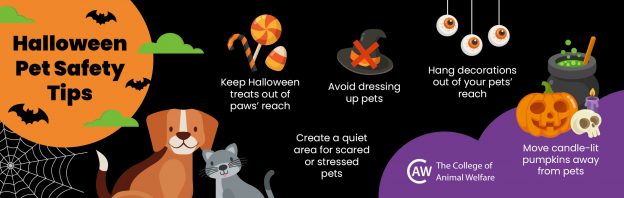
Create a quiet area for scared or anxious pets

All the extra noises and bustle that comes with Halloween can be frightening for some pets – therefore it is important to plan ahead. If you know your pets are sensitive to noise or new people, keep them in a quiet room where you can keep an eye on them. To avoid stress or an escape when the door is open to trick or treaters, keep your pet in a quiet, calm area.

Keep Halloween treats out of paws’ reach

As we stock our cupboards with tasty Halloween-themed treats in preparation for trick or treats, make sure all sweets, chocolate, hard candies and wrappers are kept well out of paws’ reach. Be aware of chocolate and hard candies floating around on the night in particular; chocolate is toxic to dogs and cats, and hard candies could pose a choking hazard.

Move candle-lit pumpkins away from pets

If you’re taking part in the popular Halloween tradition and carving a pumpkin, make sure carving tools and lit candles are placed away from your pets, to prevent any curious pets from burning themselves this Halloween. After Halloween is over, don’t forget to dispose of pumpkins safely to prevent your pet from consuming mouldy pumpkins.

Avoid dressing up pets

Whilst dressing up your pets might seem like harmless fun, costumes come with the risk of making your pets feel stressed and uncomfortable, especially if their costume obstructs their sight or doesn’t allow them to move around freely. Our four-legged friends don’t need to be dressed up to be involved in the spooky season, so our advice would be to avoid Halloween costumes for pets.

Hang Halloween decorations out of pets’ reach

Many cats and dogs cannot resist playing with dangly decorations. However, some decorations can be a choking hazard and dangerous for your pet. Make sure to keep wires, garland and anything your pet may chew on out of paws’ reach.

Be home before dark

To avoid stress in dogs, take them for a walk before it gets dark and Halloween festivities start. This way, they are less likely to feel unsettled by trick-or-treaters in costume as they will already be home. For cats, don’t forget to make beds and litter trays available if you’re shutting the cat flap for the evening.

Veterinary Nursing January

Start training as a veterinary nurse in 2023

Applications are open to study our Level 3 Diploma in Veterinary Nursing, with the next intake coming up in January!

If you’ve always wanted to work with animals, now could be the perfect time to take a leap of faith and start working towards a job you’re really passionate about. During this course you’ll get to learn from expert tutors and gain key veterinary nursing skills alongside like-minded animal lovers. Successful course completion will lead to entry onto the RCVS Register of Veterinary Nurses.

Apply to start in September

Learn all the key skills to become a successful veterinary nurse…

  • Professional Veterinary Nursing Responsibilities
  • Diagnostic Principles
  • Principles of Veterinary Nursing Care
  • Pharmacology and Dispensary Management
  • Practical Veterinary Nursing Skills
  • Anaesthesia and Theatre Nursing Skills
  • Life Stage Nursing Care and Support
  • Surgical Nursing and Patient Care

View the course content

Tips and Advice for Gaining Work Experience in a Veterinary Practice

Gathering work experience is a great way of finding out whether being a veterinary nurse is the right career for you. If you’re an aspiring student veterinary nurse, have a look at our tips and advice about how to gain veterinary work experience!

Get more employment advice

View our Ultimate Guide to a Career in Veterinary Nursing

Our online resource explores the responsibilities of a veterinary nurse in more detail, as well as the training options, career progression and more! This guide will help you gain the careers advice and guidance needed to take the next steps towards a career in this field.  

Read the guide

Why hire a veterinary nursing apprentice

Why recruit a veterinary nursing apprentice?

If you’re looking to expand your veterinary nursing team in the future, now is the time to recruit a student veterinary nurse at your practice using the Apprenticeship Standard in Veterinary Nursing.

Veterinary nursing apprenticeships have been around for some time and there are more benefits to employers than ever before. Not only do they provide an opportunity for someone to gain a qualification, gather valuable experience working with animals and enter the veterinary industry, they can help veterinary employers to expand and grow their team in a cost effective and practical way. Delivered in the right way, they can create skilled, committed, and loyal veterinary nurses, who want to progress within your veterinary practice.

Here, we’re going through some of the reasons you should use apprenticeships to recruit your next veterinary nurse:

Your apprentice goes through an employer-focused programme of study delivered by industry professionals

The veterinary nursing apprenticeship standard has been developed in conjunction with employers, meaning your apprentice will learn the most relevant and up-to-date skills required by industry. Over the course of the apprenticeship your apprentice will follow a formal, externally assessed learning structure. This will be supported by a mixture of small group college sessions and innovative online learning, led by professional lecturers who have extensive experience in the industry and really understand the role of the veterinary nurse.

Our Level 3 Diploma in Veterinary Nursing Apprenticeship covers the essential knowledge, skills and behaviours needed of a professionally registered veterinary nurse to work within the standards and scope of practice defined by the Royal College of Veterinary Surgeons (RCVS). In addition, embedded within this qualification is the content required for you to become an SQP for companion animals. Over the course of the apprenticeship your apprentice will cover:

  • Legislative compliance and regulatory requirements
  • Comparative functional anatomy for veterinary nursing practice
  • Infection control in veterinary practice
  • Materials, equipment and resources
  • Veterinary Nursing Care
  • Emergency and critical care
  • Diagnostic techniques for veterinary nurses
  • Communication
  • Self-Management

Apprenticeships offer lots of financial benefits to employers

Apprenticeships can be an affordable way to recruit new veterinary nurses whilst providing a training opportunity for someone keen to start a career in veterinary nursing. What’s more, there are added financial incentives for employers recruiting apprentices:

  • An apprentice only has to be paid the National Minimum Wage for Apprentices (If they are under 19 years of age, and for the first 12 months for anyone over the age of 19 – thereafter the normal national minimum wage applies). You can choose to pay more if you wish.
  • 95% of apprenticeship training fees are covered by the government for small employers with digital accounts. If your salary bill is over £3 million, you pay the Apprenticeship Levy. Don’t let this money go to waste. The training of the apprentice is covered by your levy payments.  If you don’t pay the levy, you pay just 5% of the training cost.
  • Take on a new apprentice aged 16-18 years of age and you may be eligible to receive a £1,000 incentive towards their training fees (in two staged payments).
  • If you choose CAW as your training provider we can help you recruit free of charge. You can also advertise your vacancy on our free jobs board.

Diversify your workforce and make use of fresh ideas and perspectives

Veterinary nursing apprenticeships aren’t just for school leavers; apprentices can be any age (as long as they are over 16 years of age). This means apprenticeships can attract diverse talent from all walks of life, whom you may otherwise miss out on. You might recruit someone fresh from school, or you could train someone who is switching careers later in life after deciding that veterinary nursing is what they really want to do. Either way, apprenticeships allow you to support your local community.

More than this, veterinary nursing apprentices bring excitement and energy into your veterinary practice. This is an opportunity for them to earn money whilst gaining a qualification and work experience in their chosen field, and they are eager to make a great impression! They bring creative ideas, and can offer unique perspectives on how to improve your practices as they learn on-the-job.

You can grow a loyal veterinary nurse that meets the needs of your practice

Apprentices often arrive in your veterinary practice as a fresh canvas, which means you can train them how you wish and teach them exactly how you want things to be done in your practice. Your apprenticeship training provider will work with you and support your apprentice to ensure they learn the skills needed to deliver on the job.

Alternatively, a veterinary nursing apprenticeship can also be undertaken by existing members of staff, for example veterinary care assistants, as a way to upskill or retrain.

Apprenticeship Training at The College of Animal Welfare

At The College of Animal Welfare, we have a well-earned reputation for excellence; delivering quality training and education and employer support. Your apprentice will benefit from:

  • Support and guidance from qualified lecturers with strong industry experience
  • Diverse teaching, learning and assessment approaches catered for individual needs
  • Access to our unique Virtual Learning Environment (VLE) and extensive eLibrary resources
  • Access to state-of-the-art clinical skills facilities

We offer veterinary nurse apprenticeship training from centres across the UK, with intakes starting throughout the year. If you’re interested in recruiting a veterinary nursing apprentice, download our guide to learn more!

Down our Employers Guide to Veterinary Nursing Apprenticeships

8 Reasons to do a Veterinary Nursing Apprenticeship

8 Reasons to do a Veterinary Nursing Apprenticeship

For those with their hearts set on a job working with animals, a veterinary nursing apprenticeship can help you pave the way to a successful career.

As a veterinary nursing apprentice, you’ll have the opportunity to gain practical skills and experience on-the-job, as well as earn a wage and pick up a qualification at the end of your programme. Take a look at the key reasons why an apprenticeship could be the perfect career move…

  1. You’ll get paid for training as a veterinary nurse, right from the very start

Veterinary nursing apprenticeships emphasise work-based training, meaning you’ll be paid for your work and benefit from having a regular income whilst learning the role of a veterinary nurse on-the-job. The National Minimum Wage for Apprentices currently sits at around £4.81 per hour*, however many employers pay more than this, and often apprentices’ earnings rise as they become more experienced.

  1. Your employer will cover the costs of your training

A veterinary nursing apprenticeship is a way to start a career as a veterinary nurse, with all of your training fees covered. Not only will you be earning a wage, you will have no course fees to pay as these are settled by your employer! In other words, you will be achieving your veterinary nursing certification and gaining hands-on experience with animals in a veterinary practice for FREE. What’s more – as an Veterinary nursing apprentice at CAW you may be eligible to purchase a TOTUM card for just £12, meaning you could make big savings on many of the top brands, including Amazon, The Co-operative Food and Odeon.

  1. Go through an employer-led programme of study

The veterinary nursing apprenticeship standard has been developed in conjunction with employers, meaning you will learn the most relevant and up-to-date skills required by industry. Over the course of the apprenticeship you will follow a formal, externally assessed learning structure. This will be supported by a mixture of small group college sessions and innovative online learning, led by professional lecturers who have extensive experience in the industry and really understand the role of the veterinary nurse.

Our Level 3 Diploma in Veterinary Nursing Apprenticeship covers the essential knowledge, skills and behaviours needed of a professionally registered veterinary nurse to work within the standards and scope of practice defined by the Royal College of Veterinary Surgeons (RCVS). In addition, embedded within this qualification is the content required for you to become an SQP for companion animals. Over the course of the apprenticeship you will cover:

  • Legislative compliance and regulatory requirements
  • Comparative functional anatomy for veterinary nursing practice
  • Infection control in veterinary practice
  • Materials, equipment and resources
  • Veterinary Nursing Care
  • Emergency and critical care
  • Diagnostic techniques for veterinary nurses
  • Communication
  • Self-Management
  1. Join an industry with amazing job prospects

A veterinary nursing apprenticeship offers the opportunity to secure a permanent position with your employer of choice on completion of formal studies. Starting out as an apprentice has proved to lead to real job prospects for many. According to research by the National Apprenticeship Service, 85% of apprentices will remain in employment on completion of their apprenticeship, with 64% of those staying with the same employer.*  If you’re looking for job security and the opportunity to progress in your career, a veterinary nursing apprenticeship could be the most secure way to develop with further education and training.

More than this, veterinary nursing is an incredibly varied and exciting profession. Upon completion of formal studies, veterinary nurses have numerous professional opportunities. You could remain in first opinion practice; move into referral practice and specialise in a particular area, train as an equine veterinary nurse, or find work in related industries such as management, research, teaching, sales or rehabilitation with further training. Read more about what you can do with a veterinary nursing qualification

  1. Veterinary nursing professionals will help you grow into your role

A combination of practical experience in a veterinary practice, college sessions and online tuition means you will be mentored by tutors and colleagues with a wealth of experience in veterinary nursing each and every day. This will allow you to develop your confidence, knowledge and practical skills faster; and make meaningful industry connections that will prove invaluable as your career develops.

  1. Get a head start in the world of veterinary nursing

If you’re an animal lover, chances are you jump any opportunity to interact with animals – whether that be by petting a cat on a walk, or putting yourself forward for dog walking or pet sitting when friends or family go on holiday. By undertaking a veterinary nursing apprenticeship, you’ll get the chance to apply your passion for animals from the get go and your work will make a real difference to the wellbeing of animals. These hands-on practical skills and knowledge of veterinary nursing will prove invaluable when it comes to seeking employment in future.

Proving you have relevant, practical experience is essential to securing your first role in any industry, but no more so than in veterinary nursing. Gaining years of experience in veterinary nursing as part of a veterinary nursing apprenticeship is therefore a significant advantage and addition to your CV!

  1. You could go on to higher study in veterinary nursing

Many people dream of achieving a degree, and studying an apprenticeship could be the start of your path to university in the future. Successful completion of the Veterinary nursing (Level 3 Apprenticeship) could help you lay the foundation for higher education (subject to individual university entry requirements). Many apprentices go on to top-up their diploma-level qualification to degree level as part of their career progression and academic development. Find out more about our top up veterinary nursing degree programme

  1. You’ll have a competitive edge

Think about where you will be on completion of your apprenticeship. You will be able to confidently perform a range of veterinary nursing duties, be qualified to apply to join the RCVS Register for Veterinary Nurses. You will have gained real world experience and skills learnt from on-the-job training, plus be able to work towards higher certifications if you wish to do so. Not only this, you’ve achieved all of this without paying a penny. Put simply, you will be turning your passion into a career – and being paid for the opportunity to do so!

If you’re thinking that an apprenticeship could be the perfect way for you to turn your love of animals into a career, start your journey with The College of Animal Welfare today! Our  veterinary nursing apprenticeship programmes can be undertaken at our centres across the UK: 

Our Veterinary nursing Apprenticeships at a glance…

Useful sources to get started

Funeral of Her Majesty Queen Elizabeth II

Dear students, staff and employers

Please note that as a mark of respect for the funeral of Her Majesty Queen Elizabeth II, The College of Animal Welfare and CAW Business School will be closed on Monday 19th September 2022.

Further announcements will be made in due course with details of rescheduled teaching along with confirmation of our partner institutions approach to the Bank Holiday where appropriate.

The College of Animal Welfare are deeply saddened by the passing of Her Majesty Queen Elizabeth II. In addition to Her Majesty’s grace, compassion and dedication towards people, Her Majesty was also a proud and faithful advocate for animals and their welfare during her reign.

Our thoughts and sincerest condolences are with The Royal Family and the rest of the nation during this terribly sad time.

How to boost income as a veterinary nurse

10 Ideas to Boost Your Income as a Veterinary Nurse

As the cost of living rises, you may find yourself taking a closer look at your finances and looking for ways to boost your income.

As a veterinary nurse you can increase your income by being proactive about your career development, stepping up to new promotions in the workplace, earning new skills and knowing when it’s time to ask for more or move on to pastures new. Veterinary professionals also turn to activities like education and lecturing, pursuing extra specialisations and certifications or doing shift work to supplement their income.

Today, we’re exploring some of these money-making ventures in more detail, and going through some specific options you can follow to try and boost your income. Let’s get started!

1. Ask for a pay rise 

If you’ve done your research and believe your experience and your salary aren’t in sync, it might be time to ask your employer for a pay rise. Veterinary nurses undertake important work in practice and you are also in high demand*, many employers will recognise this and will be open to a conversation about salary. Before approaching the conversation, make sure you’ve done your research, know what you want to ask for and can point to why you should be given the raise. If your employer can’t budge on salary, you could potentially discuss other benefits that may carry monetary value, for example a CPD allowance.

2. Seek out a role with a higher salary

If you’re looking to boost your income and open to a change, pursing a new job might be the path to more money! Average salaries for nurses often vary between different employers, so you may be able to find a new position that pays a higher salary.

As a veterinary nurse your role in caring for animals and promoting responsible pet ownership is vital, and many employers the value you bring to veterinary practice as well as to other related industries. You can seek job opportunities in first opinion practices, referral practices or larger hospitals, or even pursue a role outside of veterinary practice such as a teaching, sales or research position.

Look to companies that are transparent about pay and are raising their pay offers, for example Medivet who have recently introduced a £30k starting salary for VNs*, and The College of Animal Welfare who recently listed a £35-40k starting salary for veterinary nursing lecturers. Plus, you should also look at other benefits a company offers and what monetary benefit this can give you, for example pension plans, CPD allowances and employer-covered expenses!

3. Undertake additional qualifications and CPD to increase skills and knowledge

Continuing Professional Development (CPD) is a mandatory requirement for Registered Veterinary Nurses (RVNs), which gives you plenty of opportunity to pursue professional interests and undertake specialist training that might lead to higher paying jobs and opportunities.

By completing further qualifications and CPD courses you will nurture your technical skills and knowledge whilst showing your commitment to employers. This will stand you in good stead when it comes to seeking work opportunities and further education options. To give you an idea of the academic paths you might choose to follow, you could undertake the Level 5 Advanced Diploma in Veterinary Nursing (Practice Nurse), top up your veterinary nursing diploma to degree level if you haven’t already done so, attend regular veterinary congresses and CPD courses, or even pursue leadership and management training.

4. Look for chances to boost your salary internally with new roles or responsibilities

One way to achieve, or be in a position to argue for, a higher salary in your current position is by taking opportunities to develop in your role and stepping up to new responsibilities that offer higher pay.

Whilst in some companies internal opportunities for promotion come up regularly, in other workplaces chances don’t always arise naturally. This means sometimes you need to create these possibilities for yourself. For example, if you’re a veterinary nurse this could be offering new nursing clinics or coming up with new ways to promote the practice in the local community. You could also pursue a clinical coach role, or look to take on a management position. Read more about how to show you’re ready for a management job.

5. Grow your digital presence

When you want to learn something new, where is the first place you go? In the digital world, it is likely you take to Google to find educational websites or videos about the topic. So, if you’re passionate about a specific area of veterinary nursing, have you considered starting your own website, blog or vlog where you document your knowledge and experiences?

Social media is a brilliant platform for skill sharing, and could be a source of income as your platform grows with paid partnerships, advertising opportunities or promoting your own courses or products on your channels. You can share content and make connections in nursing forums such as VetNurse or social media groups like Vet Nurse Chatter, or even start your own community! If you’re looking for some inspiration to get started, take a look at some of the amazing veterinary nurses sharing knowledge online, such as Lou the Vet Nurse, Alex the Cat NurseScales, Feathers and Tails VNThe Rodent Nurse and many more!

6. Start a side job

Veterinary nurses are a passionate and hardworking bunch, so it might be there is another venture out there that can fit your needs and help you make extra money in your spare time. If you want to do something involving animals, you could try dog walking or pet sitting, or even hone your photography skills as a pet photographer. Alternatively, you could try something else outside of the animal care field, maybe you have other passions you could pursue as a side job. You never know, your side job may take off and become your main job!

7. Consider locum work or a contract position

As a veterinary nurse there are plenty of opportunities to stand in for staff temporarily at various practices, and doing so could be a way to increase your take home pay in a way that works alongside your existing work commitments!

Additionally, you could consider a zero hours contract position that you can fit around your other commitments, for example The College of Animal Welfare occasionally recruit for IQA and practice support positions on zero hour contracts, which allow you to pick hours that fit your individual circumstances. If you’re open to taking your skills and experience digital, you could also increase your income by offering veterinary services using a virtual veterinary platform.

8. Look at how you can reduce bills to free up more disposable income

Every month, many of us experience the same cycle like clockwork. On pay day you have a moment of delight when your pay lands in your bank account. However, this is short lived when a few days later, you find your monthly bills have left you with much less to spend on the things you really want.

If you’re looking for ways to increase your disposable income, it’s worth reviewing your regular expenses every now and again. Take a look over your budget with an eye to quick and convenient wins to minimise your costs! This could be by switching broadband providers, or finding a cheaper alternative for groceries.

Read more about how you can save money as a student veterinary nurse

9. Deliver your own CPD or look for speaking opportunities

If you feel passionate about teaching or have a little experience in a direct teaching role, it may be worth seeking out more opportunities to run a Continuing Professional Development (CPD) course for a local training provider, or speak at a veterinary event. For example we deliver a host of virtual congresses throughout the year and we’re always looking for new contacts and speakers. If you’re interested in supporting one of our events, take a look at what events we offer and contact our events team on 01480 422060 or events@caw.ac.uk with some more information about your background and specific knowledge base.

10. Sell unwanted items

When was the last time you had a good clear out? Many of us hang on to items we no longer need out of convenience or a sense of sentimentality. However, what we see as clutter could be exactly what someone else is looking for. ‘De-cluttering’ isn’t just an effective and quick money making exercise, it is also an opportunity to boost your mental wellbeing by creating more space and order in your home.

Take a look through your home and sort through items like books, games, clothing, toys, gadgets or even furniture to see if there is anything you no longer need. You can use online marketplaces such as Facebook marketplace to sell items locally, which may sell faster.
Subscribe to receive updates about our courses, CPD and events for veterinary nurses

* indicates required
School of Veterinary Studies

CPD, Short Courses and Congresses

How to save money on pet care

How to save money on pet care as the cost of living rises

Having a pet to love and look after is incredibly rewarding, however with bills rising it can also be difficult to keep up with the cost of caring for your furry friend.

Whether it be the cost of your weekly shop to the price of filling up at the petrol station, we’ve all noticed the price of things going up and many of us are beginning to feel the pinch. A troubling reality is that many pet owners experiencing growing financial pressures face the devastating possibility of having to give up their beloved pet. Research by the RSPCA revealed that 78% of 4,000 pet owners feel the cost of living crisis is going to impact on their animals, with 19% saying they’re really worried about being able to afford to feed their pets*. Not only this, according to The Dogs Trust, the number of owners contacting them about giving up their dog has “risen to the highest levels” since 2014*.

With the cost of living continuing to rise, today we’re exploring some of the ways you can save on some of the common costs that come with pet ownership. Read on to find out how you can provide your pet with what they need on a budget…

  1. Shop second hand for toys, bowls and other supplies

Every pet parent likes to treat their pets, however it’s no secret that all of these costs add up over time. Research conducted by the PDSA showed the average dog could cost £30,800 over its lifetime – and for cats, the average annual cost is around £1,000 according to Battersea Dogs & Cats home.

Whether its toys, bowls or other supplies, you don’t always have to buy brand new – purchasing pre-loved goods is a great way to save you some extra money. Plus, you’ll be doing your part to help the environment. You can get some fantastic second hand goods from places like charities or online marketplaces such as Facebook Marketplace and eBay. However, it’s important to make sure the goods are safe and undamaged before use, and properly disinfected to prevent infection from one pet to another.

Generally speaking, take time to consider whether you really need an item before committing to the purchase. As many cat owners will testify, often your pets will get more enjoyment and comfort from playing with (or sleeping on) things that you already own than they do from the new products you buy for them. Often, there is no need to splurge on over expensive and overrated pet gadgets – lots of toys can be made at home and there are lots of free forms of entertainment and exercise such as a simple walk in the park.

     2. Educate yourself about your pet’s grooming requirements

We all need a good trim every now and then and the same goes for our pets – however, some pets need it a bit more regularly than others, and those trips to the groomers can be a big hit to your bank balance!

It’s important not to neglect your pet’s grooming requirements, as grooming is a crucial preventative measure against painful matting, overgrown nails or skin-related problems. However, with the cost of living crisis squeezing finances, you may find yourself in a position where you need to increase the time between professional dog grooming visits. If you find yourself in this position, learning more about how you can groom your pet from home can help you keep your dog’s coat in good condition in the meantime.

This starts by researching what kind of grooming your pet needs, what tools you need to do that and seeking advice from qualified dog groomers. If you do decide to groom your pet from home, make sure you build up your pet’s comfort by making it a really positive experience with treats and praise to help. If in doubt, contact a professional dog groomer or local vet for advice on how regularly you should groom your dog and if there are any hazardous areas to be aware of for their breed. Check out our advice and tips for grooming your dog from home

It’s worth exploring the different dog grooming services in your area and you could consider switching to a cheaper service if you find one. You could also consider taking your pet to a dog grooming school such as CAW Grooming School, where prices are sometimes cheaper as grooming is completed by dog grooming students under the close direction of qualified dog groomers.

  1. Bulk by pet food and seek cheaper alternatives where possible

You can make savings on your pet food by buying in bulk when it’s on sale and looking out for lower cost options. You can also look to places like charities, food banks or food waste reduction apps such as Too Good to Go for discounted or even free pet food. The key thing is to ensure your pet is getting a well-balanced, species-appropriate diet – you can gain professional advice and guidance from your vet or veterinary nurse about your pets nutritional needs.  

More than this, chances are that your go-to pet store rewards loyalty. Subscribe to and follow your favorite pet brands to keep your eyes out for offers, discounts and promotions on products you like. It is also worth following reputable animal welfare organisations on social media to stay up to date with hints and tips to keep your pet safe and healthy.

  1. Shop around for the best deals on pet insurance

At first investing in pet insurance may seem counterproductive, especially if your pet isn’t insured already, as it usually means paying a monthly fee or making a larger one-off purchase. However, taking out insurance may help in the long run as it may be cheaper than the big one-off bill you would receive in the event of a veterinary emergency.

If you already hold pet insurance it’s worth comparing prices between companies for like-to-like cover, just as you would look for the best deals on utilities or any other product. Just make sure you read the small print to be sure what’s included and choose something that is suitable for your pet and their individual circumstances. This can save you money on annual fees like yearly vaccinations, vet visits, even major surgeries and other procedures.

  1. Ask friends and family to pet sit or dog walk

Going to work to earn money, or going on holiday, but not having anyone to look after your pet – it’s a dilemma.

While the pet sitting options for pet owners are varied, options like pet boarding or pet sitting services can be expensive – especially if you’re having them stay overnight. Instead, having a friend or family member watch your pets is another great way to save yourself money. Some people may be happy to do it for free, while others could request a small fee.

You could also consider neighbours that might be able to help, or other dog owners in the area where you might be able to form a group between you. Another option is using websites such as Borrow My Doggy for support with dog walking if needed.

  1. Take good care of your pet

Just as with humans, prevention of illness is really valuable. So, saving money on healthcare also means doing what you can to prevent illness in your pet. This involves keeping your pet on a healthy diet to maintain an ideal weight, brushing their teeth to help prevent costly problems with tooth decay down the road and getting your pet vaccinated and protecting them from pests, such as fleas and ticks, that can carry disease.

In your home, do what you can to guard against injuries by looking around your living space with an eye for pet threats. Pet-proof your home by keeping potentially dangerous items out of paws reach, for example electrical cords, household chemicals, trash cans, medications and breakable décor.

When it comes to saving money on veterinary costs, you should be proactive about visiting the vet if something is wrong, as catching medical problems early will minimise overall treatment costs as well as boost your pet’s quality of life. If you suspect something is wrong with your pet, don’t ignore the signs or wait for an injury to get infected or strange symptoms to turn into an illness. Some veterinary colleges and veterinary charities offer veterinary care at reduced rates; so it’s worth keeping an ear on the ground for low- or no-cost services in your area. As a starting point, take a look on the RSCPA website for payment options and sources of financial help for veterinary care.

More than this, your vet will write the prescription for medications, however costs can vary for the same medication, so it’s worth asking your vet if they can write a prescription to use online or take it to a pharmacy where the price may be lower. 

Follow our social media channels to be the first to see our latest articles, advice and guidance:

[ss_social_follow networks=”facebook;twitter;instagram;linkedin;pinterest”]

VCA Congress

Join us at VCA Congress this Autumn

What is VCA Congress?

VCA Congress is a one day virtual event focused solely on roles within the varied veterinary care field – exploring all aspects of the roles; from the many different responsibilities, to the challenges that are faced on a daily basis.

You’ll get the chance to listen to a variety of relevant lectures from expert industry speakers and gain valuable CPD on topics including…

  • Client Care for the VCA
  • Compassion Fatigue: What Veterinary Teams Need to Know
  • An Introduction to Patient-friendly Practice
  • *Optional stream* Next Steps: The Veterinary Nursing Diploma Route…
  • First Aid – How can I help?
  • Anaesthesia Monitoring: Putting together the pieces of the puzzle

Download the agenda

Boost your knowledge of veterinary care, with the guidance of expert speakers

Expert industry speakers will be joining us at congress, to share their wealth of knowledge and experience during informative lectures. We are delighted to announce our speakers as…

  • Dr Liz Walker BVetMed BSAVA PgCert SAM MRCVS from IntinsiaVet
  • Dr Rosie Allister BSc (Hons) BVSc MSc PhD MRCVS from VetLife
  • Linda Ryan BSc (Hons) Animal Behaviour and Welfare, VTS (Behaviour and Oncology), DipAVN (Medical), KPA-CTP, RVN, CCAB from Inspiring Pet Teaching
  • Louise Chappell BSc (Hons) Dip AVN RVN from The College of Animal Welfare
  • Courtney Scales DipVN, NCert(Anaesth), RVN from Veterinary Anursethesia
  • Claire Hobson RVN Cert Ed Canine Hydrotherapist from The College of Animal Welfare
  • Lisa Forrest BA(Hons) GTP from The College of Animal Welfare

Find out more about the VCA Congress speakers

Who should attend VCA Congress?

This congress is suitable for those studying for a Veterinary Care Support or Veterinary Care Assistant qualification, as well as for those already working within these roles and similar roles, within veterinary practices and animal care environments. The congress will be particularly useful if you are:

  • New to your role and looking for some guidance
  • Interested in learning more about veterinary care
  • Aiming to progress within your role
  • Interested in progressing onto veterinary nurse training in the future
  • Interested in keeping up-to-date with everything happening in the industry

Find out more about the event

Why attend VCA Congress?

  • Listen to lectures from a range of speakers who will be sharing their experiences and knowledge
  • Q&A sessions mean your questions will be answered by the speakers themselves
  • Gain practical takeaways on a variety of topics that you can implement in your practice
  • Earn 7 hours of evidenced CPD
  • Gain information, product knowledge and offers from our virtual exhibitors
  • Gain online access to recordings of all the lectures and lectures from previous congresses up until the next event

Book your place today

Countryside and Environment

Why Join the Environment Industry?

Working in the countryside is a worthwhile ambition if you’re looking for the chance to turn your passion for environmental issues and wildlife into a rewarding, lifelong career.

Rapidly changing eco-systems and ongoing environmental challenges mean that more people are taking an interest in what we can do to safeguard our planet than ever before. Today, we’re going through some of the main benefits to joining this fantastic industry:

  1. Environmental protection is an important sector

Environmental protection is an important field that impacts our lives every single day.

Managing our land responsibility in the face of widespread industrial progress and ongoing environmental challenges is one of the biggest challenges we currently face. With an ever increasing demand for the use of rural space and the provision of renewable energy, it is crucial that our wildlife land areas are managed and protected successfully. As such the countryside and environment industry works to maintain land in a responsible way, and improve the habitats of our wildlife.

In the face of these challenges you may feel defeated, or they may inspire you to take action – either way, our responses reveal just how vital protecting our environment is for our present and future. If environmental sustainability and environmental health is a message that resonates with you, then you may be looking for a career in the environmental sector.

  1. There’s varied career options in the environment sector

One advantage to entering the environmental sector is that it is really varied. You can choose from a wealth of career paths with varying educational and professional requirements depending on where your passion lies – you could be anything from a Countryside Ranger or Gardener, to an Ecologist, Hydrologist or Gamekeeper – and that’s only scratching the surface of the options available to you. Working in the industry, you could be involved with monitoring animal populations, managing land sustainably or researching and conducting ecological surveys. Take a look at the national careers service environment career profiles to look at the options open to you.

  1. There are opportunities to work from anywhere in the world

Our environment is constantly changing; and faces a number of ongoing threats to its future conservation, such as: pollution, deforestation, overpopulation, and global warming. These threats transcend national barriers, affecting populations and wildlife both in the UK and overseas. With so many possibilities as far as which sector you can work in, there are many different ways you can make a difference around the world.

As an environmental professional you may conduct your work in an office, or you could be spending time out in the field — which could be a country park, a mountain, beach, seashore or any other type of environment. In essence, working on environmental matters could bring you out into the nature you love on a daily basis.

  1. You can better understand the planet and how we can protect it

By working in the environment industry you will gain wealth of background knowledge and awareness of environmental issues, and how they can be tackled through various management and conservation methods, which can in turn help you to look after our natural resources. You will be a part of important work to prevent problems that come when we fail to care for our natural resources, including species extinction, spread of pollution and permanent geographical changes.

  1. You’ll be able to embrace a passion for nature and make a real difference to the planet

As an environmental professional, you have an opportunity to help influence environmental change and turn it into something positive. Ensuring that our habitats are conserved is a worthy mission that brings high levels of job satisfaction and a strong sense of personal achievement. If you’re looking to put your passion for the outdoors to good use, then a career in environmental management and sustainability could be for you!

Get qualified doing a job you love in the countryside with our Level 2 Diploma in Countryside and Environment

Ideal for those looking to begin a career in the countryside and environment industry, our Level 2 Diploma in Countryside and Environment course will give learners an introduction to the principles behind environmental management and conservation. This programme is also suitable for those already working in the industry who would like to expand on existing skills by gaining a formal qualification. If you have a passion for the outdoors and are interested in learning about how to improve the habitats of British wildlife, this course is a great opportunity to gain valuable industry experience, whilst working towards a recognised qualification that complements your practical skills.

Hand on a horse

We’re expanding our Equine Veterinary Nurse training, and applications are open now!

If you’re passionate about horses and searching for a job doing something you love, we’re pleased to say applications for our Level 3 Diploma in Equine Veterinary Nursing, starting in September 2022, are now open!

In our biggest expansion of equine veterinary nurse training to date, as well as delivering our annual intake from our centre in Huntingdon (Cambridgeshire), this year we’re also offering the option to study from two NEW satellite centres in Lichfield (Staffordshire) and Horsham (West Sussex)! 

Our Level 3 Diploma in Equine Veterinary Nursing will teach you the clinical skills and knowledge needed to prepare you for a successful career as an Equine Veterinary Nurse. Applications for the September intake close on Saturday 6th August, so be sure to submit your application soon!

Apply to start in September

Get the key facts about our Level 3 Diploma in Equine Veterinary Nursing, at a glance…

  • Starting in September 2022
  • 2 year course
  • Weekly virtual college sessions, plus practical skills training blocks from your chosen centre
  • Apprenticeship option available

Download the course infographic

Learn how to gain experience in an equine veterinary practice. As a starting point, you should…

  • Check online job boards
  • Follow veterinary colleges and employers on social media to be the first to see new roles
  • Contact your local veterinary practices directly to enquire about opportunities
  • Attend relevant career events such as Careers With Animals Day

Discover more employment advice

Is Equine Veterinary Nursing the job for you? Find out with our free careers guide…

Our Guide to Equine Veterinary Nursing is the go-to place to learn whether becoming an Equine Veterinary Nurse is the path for you. This guide explains what the role involves, how to start training, what you can do to progress in the job and more!

Get the career guide

[ss_social_follow networks=”facebook;twitter;instagram;linkedin;pinterest”]